Storm Doris blew through the wood on 23rd February this year. With a name like Doris the storm sounded like it would be quite a friendly affair. A bit like Deidre or Dorothy. I imagine storm Dorothy would have been a strong wind with pigtails, red slippers and three friends dancing and singing arm in arm between the trees before resuming their route on the yellow brick road. In reality storm Doris was a violent event causing a lot of damage on its passage across the UK. However, on this occasion nature’s destructive power was actually a positive development for Pop’s wood.
A couple of weeks earlier in February I had arrange to meet with Justin from the Forestry Commission in the wood with a view to getting some advice on the wood itself, my outline management plans and the health of a few specific trees. One of these trees was a huge turkey oak. The tree had a 13 feet (4m) circumference at chest height which indicated that it was at least 250 years old. When this tree was starting out George III was the new king, slavery had just been outlawed in the UK and they were having a tea party in Boston. However, at some stage it had been infected by a large bracket fungus. Justin was very knowledgeable and was clear that the bracket fungus (see picture below) growing at the base of the then standing turkey oak was actually killing the tree and that I would be well advised to pay to have it cut down before it fell down!
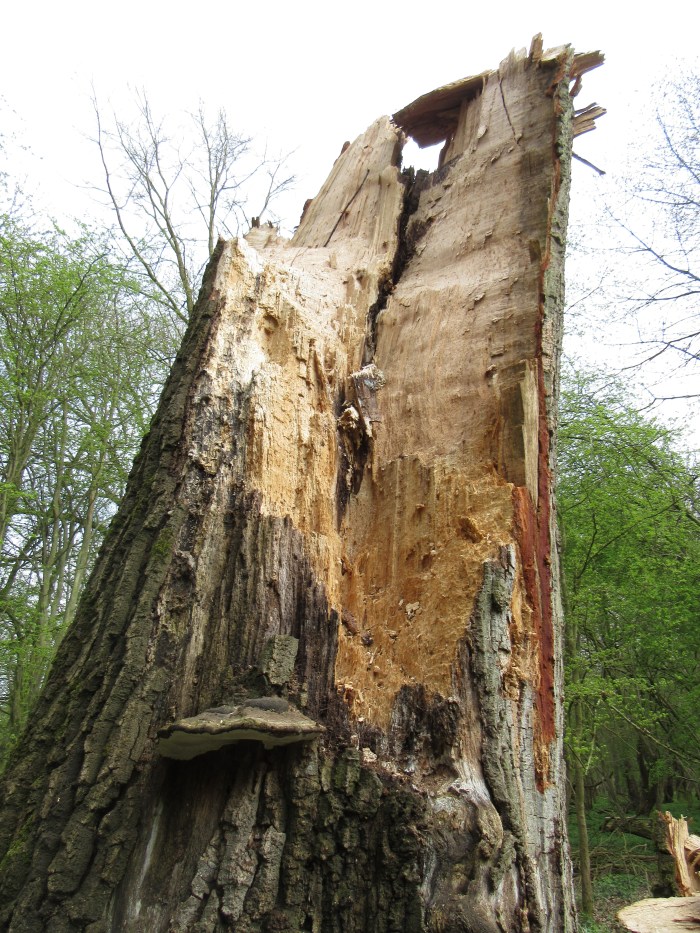
Whoops before I had a chance to think this through Doris had been along and the tree was down – problem solved.
Now what to do with the fallen tree?
Even though the tree was weakened at its base the large majority of the wood is perfectly suitable for firewood and so I started the process of sawing it up into manageable sections, splitting and drying all the resulting logs.
The job of processing the tree didn’t seem daunting until I actually started. It is a big tree and because of the violent way that it had come down there was a lot of damage done to the main trunk and branches, most of them had become twisted and so potentially stored a lot of tension which can be dangerous if it is suddenly released when cut through. So the task has turned into a giant game of “Buckaroo”, trying to work out which branches were resting on which others to determine the sequence in which to cut them.
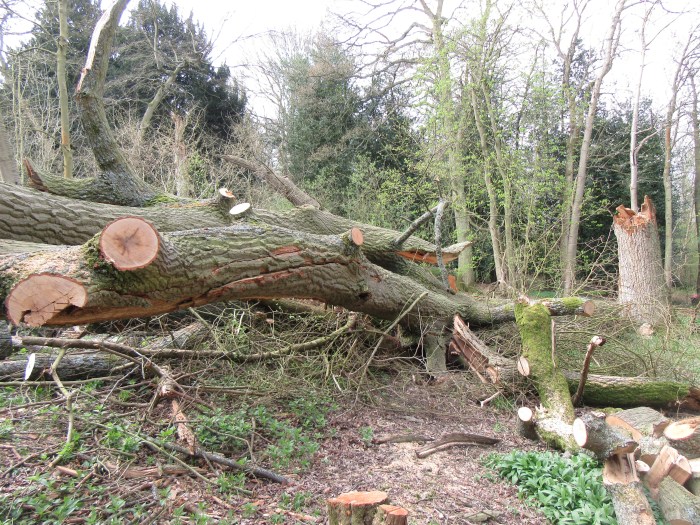
I was lucky on the first weekend to be joined by Paul and his two young lads Finley and Oscar. They all turned up one rainy Sunday morning equipped with their own hand saws and eager to get stuck in. We tackled a couple of the lower branches and, after I cut them into manageable chunks with the chain saw, Paul expertly split the logs with his axe much to the delight of the lads and we loaded their car up to the point where the boot lid just closed. Oscar and Finley had different approaches to tackling the sawing; after an initial enthusiastic start Oscar defaulted to his ipad; Finley however carried on with the chopping and sawing and I think if left in the wood would have worked his way through the entire tree making a pile of kindling sticks that would have been visible from space.
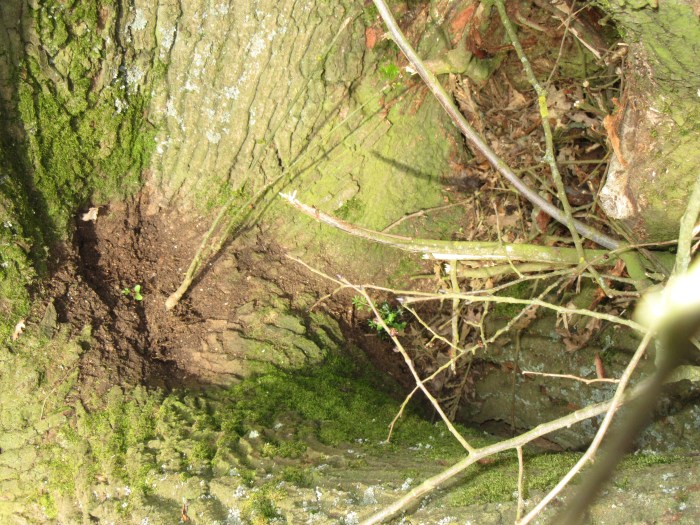
The job continues and today I was clearing the last of the side branches and getting to the main trunk and branches. Right at the point where the trunk finished and the branches started to branch off, in the bowl of the tree, I noticed that there was an ash sapling and a holly tree just starting to grow. A tiny bit of soil had accumulated in the small depression having presumably been washed in over the years and the seeds dropped by birds or blown in somehow had successfully germinated So some 40 feet up in the air the oak had two tenants, who knows how big they would have become if the tree hadn’t fallen over.
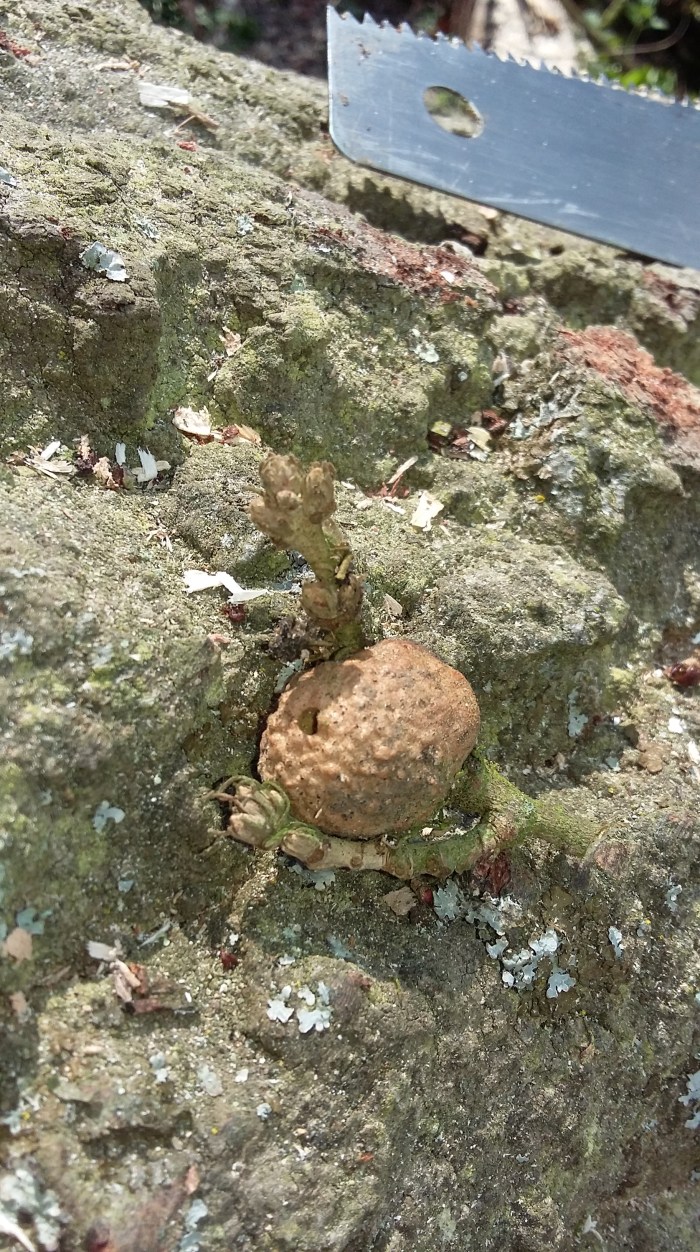
Towards the end of yesterday I was beginning to clear up when I found an oak apple. This is an abnormal growth or gall apparently caused when an adult female wasp lays a single egg into a developing leaf bud. They are quite common but I hadn’t noticed any others to date. The picture below shows the apple which is about an inch across, it has a tiny hole in it presumably through which the wasp larva breathes and ultimately escapes.
More on the processing, two devices that make my life in the wood easier and anything else that catches my eye next time.

 Tim Burr