There was very little breeze today at Pop’s wood and the smell of the bluebells was in the air. Apparently the native British bluebell has a stronger scent than the Spanish ones and its not until this time of year that you remember their beautiful smell. Quite a scene with the bluebells getting to their best, the wild garlic in flower and the bracken just beginning to unfurl.


Opposite the entrance to Pop’s wood is a field normally occupied by a herd of sheep but empty at the moment as presumably the sheep are in a shed somewhere near the farm for lambing. As I drove up on Wednesday there were six red kites circling low over the field and landing in the top of a large oak tree. Given that until recently the red kite was in what appeared to be terminal decline (a book I have at home on British wild birds published in 1982 describes them as very rare!) and were only managing to hold on small numbers in Central Wales this is an amazing success story. They are a large bird with a wingspan of over 5 feet (165cm), they glide effortlessly soaring on thermals and sometimes you hear their mewing call a bit like a kitten.


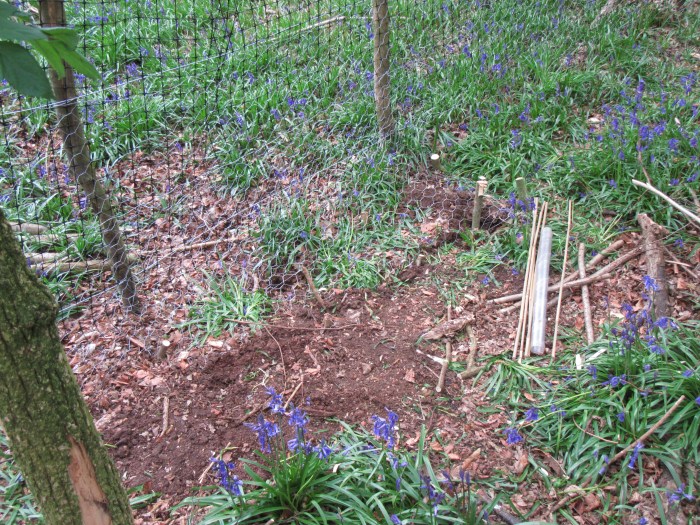
As usual my first job is to check the hedge row and the fenced off compound for any signs of damage. On Wednesday there was evidence of an attempted forced entry. At a part of the fence that covers an old dip between two raised flint mounds, someone/something had been digging and undermining the wire mesh section at the bottom of the fence. Difficult to see if they had been successful and actually gained entry into the compound but none of the hardwood cuttings were damaged and none of the hazel regrowth had been eaten so I assumed that they had failed in their attempt. The usual suspects are the muntjac deer and the badger. My money is on the badger given their previous with the hedgerow. So I spent the first hour or so letting in a new piece of wire mesh but this time burying a section of it into the ground to a depth of some 4 inches or so to make it less likely that the next attempt would succeed either. Clearly fence maintenance is an aspect of woodland management on which to be super vigilant as it would be such a shame to have all the regrowth nibbled off in a muntjac/badger “come dine with me” special.
Work on processing the fallen turkey oak continues. Each section that is chain sawed off the main tree has to be split and stacked so that it can dry out or “season” over the summer. This is very satisfying work on the whole but has its frustrations. Each bit of wood is subtly different with some splitting easily, straight along the grain whilst others appear to be straight forward but prove to be very difficult and time consuming due to the convoluted nature of the grain in and around branches and hidden knots.
Here is a very short video of a straight forward log splitting, it has a very satisfying noise a bit like the sound of leather on willow as a huge six is dispatched over the pavilion.
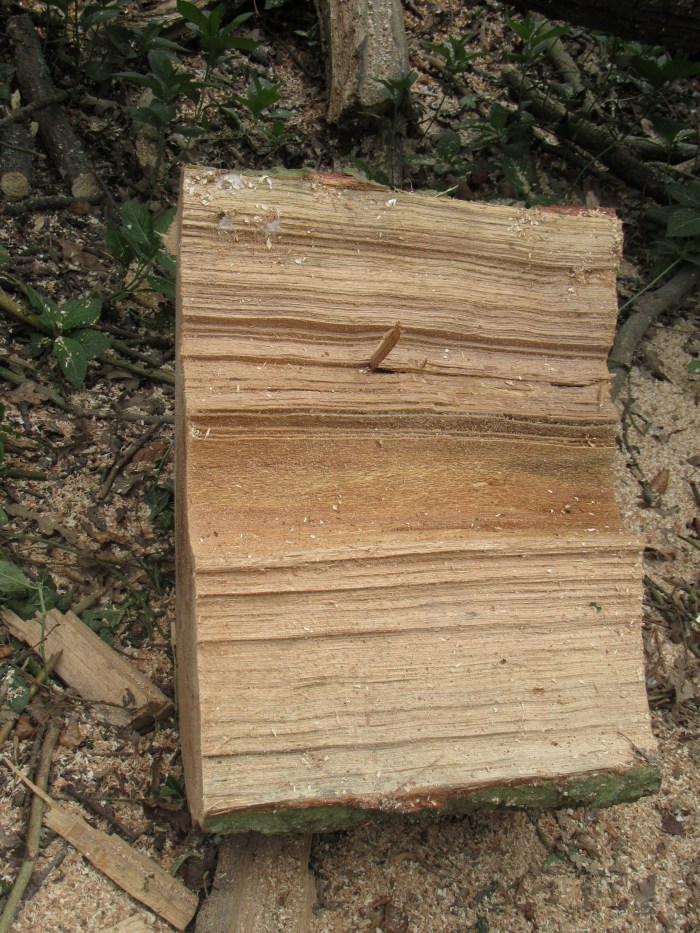
The grain in wood is part of the beauty of a finished piece of furniture, the various flecks and deviations from the straight line detailing intricate internal patterns and gorgeous natural artistry. However, rather selfishly when splitting wood you would prefer every piece to have perfectly parallel grain running absolutely straight from top to bottom rather like the picture below.
That of course doesn’t always happen; here are a few examples of more challenging logs to split where the axe hasn’t been left in for the photograph to add scale or interest – it is actually stuck:


I mentioned two efficient “devices” last time. These two pieces of kit are rather humble, non glamorous and low tech but make the task of splitting and stacking significantly easier .
Firstly, the axe – the axe is amazingly efficient at splitting wood along the grain. What can be achieved in a split second with one blow of an axe would take several minutes with a chain saw and 10’s of minutes with a hand saw. Incredible how such a simple tool that originated with our ancient ancestors is still one of the best to use even in our super technologically sophisticated modern world.
Secondly, the wheelbarrow – not glamorous at all but essential for moving all those split logs to the log pile. I don’t know how to accurately calculate the efficiency of a wheelbarrow but I reckon I can carry up to three times the load in weight and many times more in terms of the number of pieces that I could physically grasp in my arms. So that in my very simple terms makes the simple wheelbarrow capable of making me three times more efficient. If only I had had one when I was working for a living!
More on stacking the logs next time…..

 Tim Burr