There has been a bit of rain over the last few days which after weeks of dry weather was very welcome for the hedgerow and the hardwood cuttings. Most of the trees are now fully leaved and the others like the ash and oak are well on their way to growing this year’s canopy. The immediate effect of this leaf growth is to reduce the amount of rainfall and sunlight reaching the hedgerow and so slow down its growth from here on.
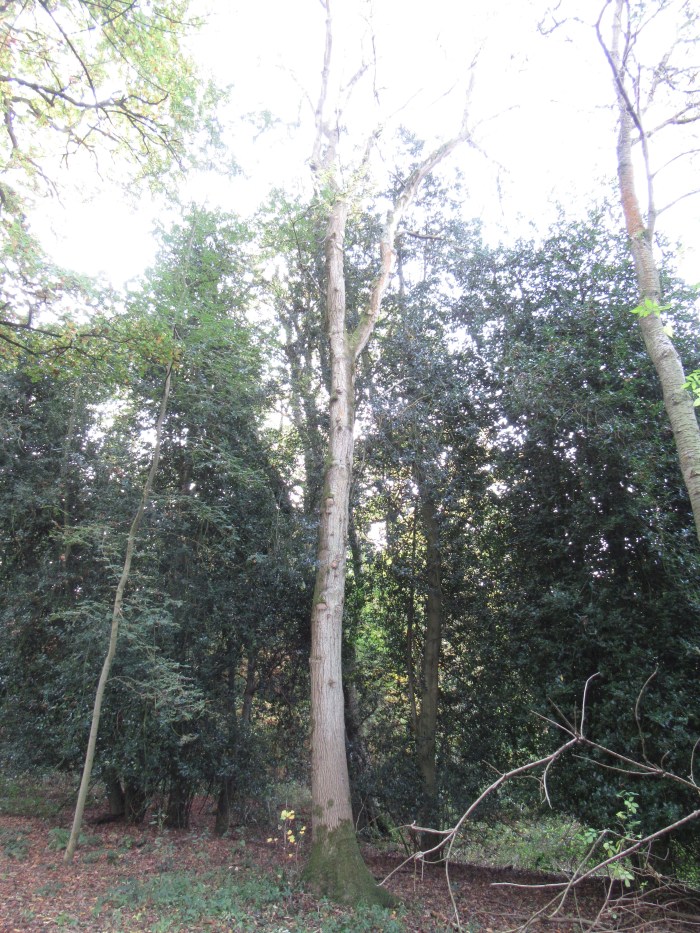
After inspecting the hedgerow I make my way back to the van usually following a badger trail through the wood. This part of the wood was replanted as a pinewood plantation about fifty years ago with a mixture of spruce and larch making it quite shady. But there are also some hardwoods that survived the previous clear fell and have grown alongside the softwoods. Part of the management plan will be to thin out the softwoods and so open up the canopy, this will give more room for the oaks and ash to grow. With less leaf cover more sunlight will reach the woodland floor once again. This should encourage regrowth of perhaps some further hardwoods but certainly more woodland flowers in the short term.
Several of the larch have brambles growing up their trunks and in some cases these brambles have somehow managed to hang onto the larch as it has grown and now extend from the woodland floor all the way up to the top of the tree some sixty feet high.
All the green leaves that can be seen at the top of the tree are the new leaves of the bramble, sixty feet above its roots. Makes me wonder how the plant manages to pump water and nutrients all the way up to the top; bit like a giraffe’e heart trying to keep the blood going through its head at the top of that long neck. My apologies for the shaky camera work.
Processing the fallen turkey oak started at the ends of the branches and has progressed from thinner to thicker diameter logs. I mistakenly cut the smaller diameter branches into 10″ lengths as I thought that this would be a good size for most stoves and save double handling later on. However, I have now realised that the logs should be say 2′ long as this makes them a lot easier to stack. The problem with smaller, shorter logs is that they don’t balance on each other above say six layers. They become very unstable and fall down like a set of dominoes. My attempt at a Norwegian style circular pile was going well until it reached waist height then, as I placed one more log carefully on the top, it all slowly collapsed in a heap at my feet. “Oh bother” I remember saying. My technique has now developed into building a straight sided, rectangular pile with larger logs forming very stable corners and all the odd ball shaped, difficult to balance logs being thrown into the space created in the centre.
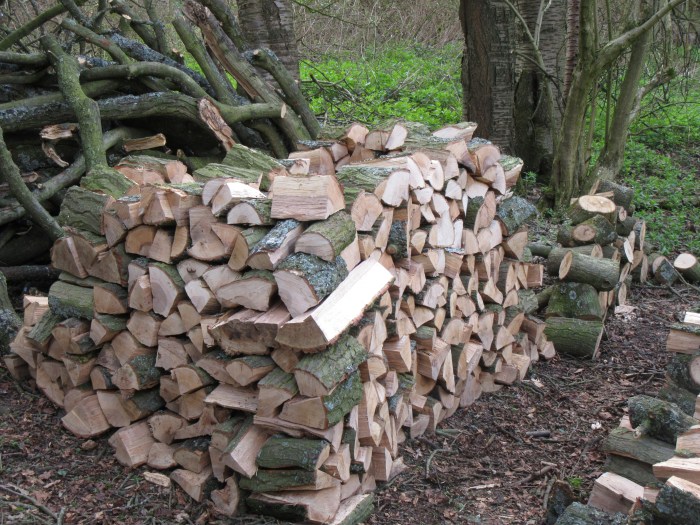
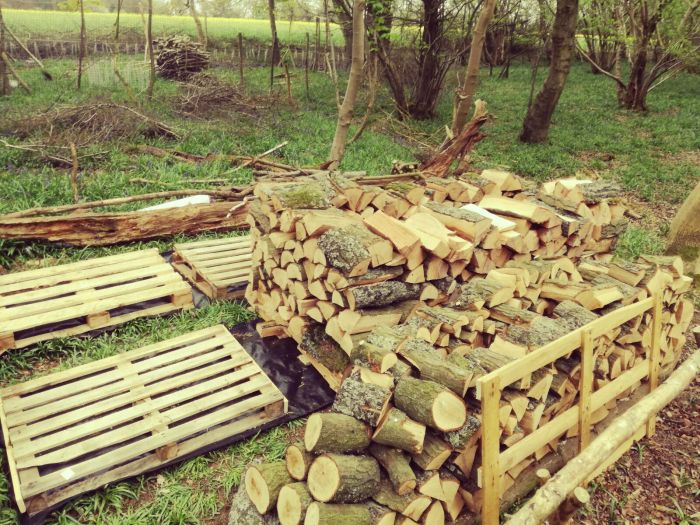
This shape seems to work very well and has remained upright now for a couple of weeks. I just need to move them from where they currently are, which is adjacent to the fallen oak, to the top of the wood where they will get more sunshine and wind. This should allow them to dry out (season) nicely over the summer and reduce the moisture content. I have also picked up a number of used pallets to stand the piles on so that they are off the wet ground and have air circulating all round them. The wheelbarrow will come into its own during this transfer stage. Maybe I should have a “bring a wheelbarrow” party…..
I got back from walking through the woods at the back of the house the other day and noticed that I had a dozen or so small green caterpillars on my jumper. These are about an inch long and at this time of the year dangle down from the hornbeams on long threads swinging about in the breeze. I have no idea what sort they are and so am not sure what sort of butterfly or moth that they will turn into later in their life cycle. Nor do I know why they have adopted this abseiling approach to getting out of the trees onto the ground. Perhaps I will do a bit more research and see what I can find out.
More from Pop’s wood next time.

 Tim Burr