The colours in and around Pop’s wood are vivid at the moment. As you walk through the top half of the wood there are a series of snatched views looking out over the deepening blue of the carpet of bluebells towards the surrounding fields with their lemon yellow flowering rape seed. This colour chart contrast is further accentuated by the shade of the woodland and the full sunlight on the crop – again I am not a photographer and it is difficult to faithfully catch the colours, I am sure a professional could do this scene much better justice. However, what neither of us would be able to capture is the smell of the wood after a short shower of rain; the wild garlic mixed with the scent of the bluebells – amazing. Sadly the bluebells are now just getting past their best but is has been a lovely month long display this year or maybe they are always this good and I have just been paying more attention. If you have a chance this weekend go into the woods and take a few deep breaths to capture the smell of spring before it disappears on the breeze for a another year.
The turkey oak that was blow down by Storm Doris was infected by a bracket fungus and its structure had been greatly weakened by this infection. It is not until I have started to process the bottom of the main trunk that the evidence and extent of this infection has become apparent. Here are a few pictures of the bracket fungus that I took in October last year when the tree was still standing.


The fungus is in the shape of individual shelves or brackets of about 8 – 10″ a the widest point. This variety is commonly known as the artist’s bracket and is a very common perennial bracket. Perennial means that it grows year on year at the same location rather than dying at the end of the year. The underside is creamy white and can apparently be scratched with a sharp point to leave brown marks and so produce artistic images – hence the common name. Its formal name is Ganoderma applantum. Shining skin is the literal translation of Ganoderma, which comes from the Greek words Ganos, meaning brightness (or shining); and derma, meaning skin, although my specimens didn’t appear to have particularly bright shiny surfaces. Applanatum refers to its flattened or plate like shape.
This tough bracket is documented as being capable of living for many years, developing noticeable annual growth ridges on the upper surface. You can just make these out on the left hand photograph. In the autumn it releases several billions of spores that are rust brown and get carried away on the wind and perhaps passing animals. You can see a dusting of spores on the nettle leaves below the photograph on the right.
This fungus starts on the outside of the bark but as it matures it grows into the very heart of the tree itself. It eventually establishes a huge network of black threads called a mycelium which in our case is present throughout the entire main trunk of the tree. This network of filaments feeds on the nutrients passing through the centre of the tree taking away goodness from the tree. The fungus is truly parasitic and eventually it kills the tree from the inside out taking away the nutrients and compromising the tree’s strength making it susceptible to strong winds or simply collapses.
Here is a short clip showing the route from the bracket to the heart of the tree where it develops its black threaded network.
The extent of the network of the fungi’s reach is better shown on the clip below which was only revealed once I started to cut the trunk up for firewood.
Here is a single filament or thread extracted from the mesh and placed against a cut log.
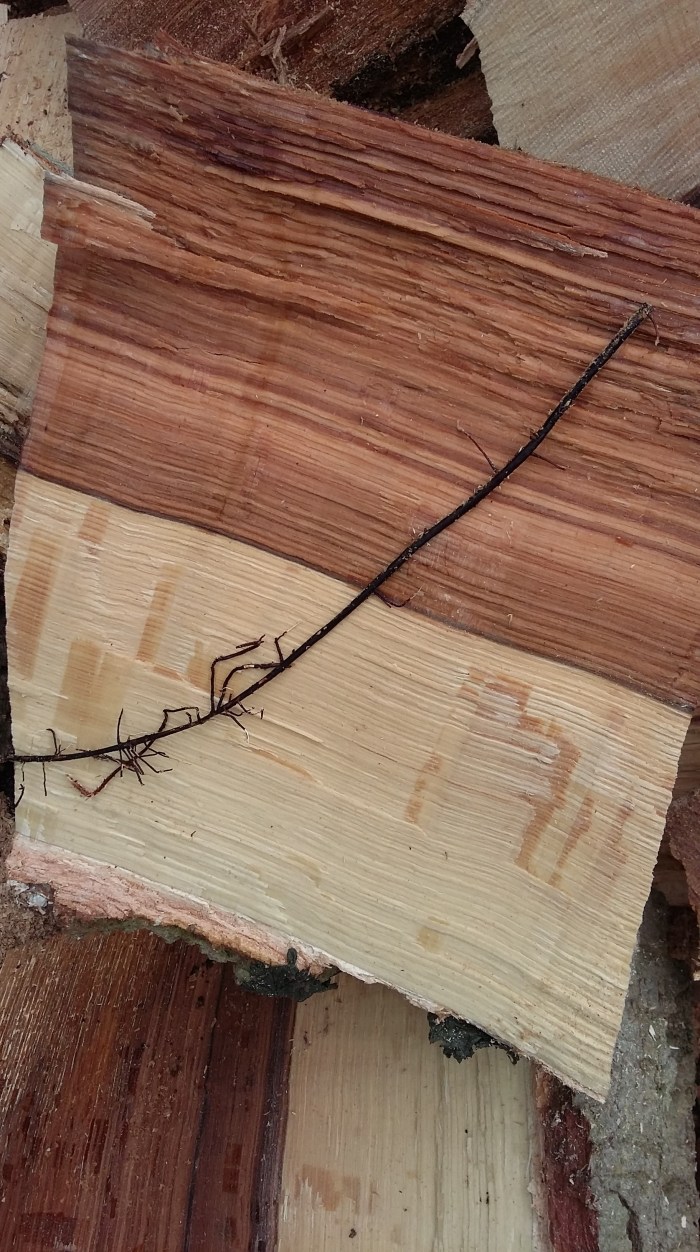
It is amazing how efficient the fungus has developed its approach to survival. Incredible to think that a tiny organism which started out as a microscopic rust coloured spore can bring a mighty 250 year old oak to its knees just through internal attrition and time – oh and a very strong wind.
Some videos next time of the things that come out when the wood is quiet.

 Tim Burr