I have to admit that I was nervous earlier this year when I carried out my first attempt at coppicing a couple of overgrown hazel trees. The contrast between their healthy growth of sturdy stems albeit hopelessly overgrown to the denuded stumps that were left was stark. The impact on the immediate area around them was also dramatic, where once there were a couple of very solid trees now there was nothing. The coppicing course that I had attended down in Shropshire and held on the top of Wenlock Edge in November, gave me the confidence to tackle the project. It also assured me that the stools would recover and go on to be healthier and last longer than before. So it would now seem. The photographs below show before and after shots of the first stages of the coppicing process. The top left hand picture shows the hazel trees immediately before coppicing began. The bottom left hand picture is immediately after the coppicing was completed. The one on the right shows the stools earlier this week happily with vigorous regrowth from all around the diameter of the each stool base which means that fresh roots are being made. This strengthens and rejuvenates the stool itself and is the first phase of the the 8 year coppicing cycle. Always satisfying when you can put the theory and training into practice.


Had a very interesting day at my older brother’s house earlier in the week when we had a test firing of a charcoal retort that he has fabricated from scratch. Here are some pictures and a short video which are probably the best way to show what we got up to and how the retort performed.


From left to right:
- Retort before filling with lid removed;
- Inside of the retort showing the larger diameter chimney and the smaller diameter tube that returns the fumes off from the wood in the retort back into the burning chamber; and,
- The retort lid and removable chimney.


From left to right:
- Retort being filled with seasoned beech logs;
- Nearly full and ready for firing; and,
- Fire lit in the combustion chamber and steam being driven off the logs in the “oven”.
There are distinct phases to the baking process that eventually produces charcoal, one of which is when the “wood gases” are driven off from the logs in the oven. These gases then are channelled down the smaller diameter tube and directly fed into the flames in the combustion chamber to further fuel the process. Here is a video of that part of the process.
And after about six hours we were left with quite a lot of charcoal (11kg)…..
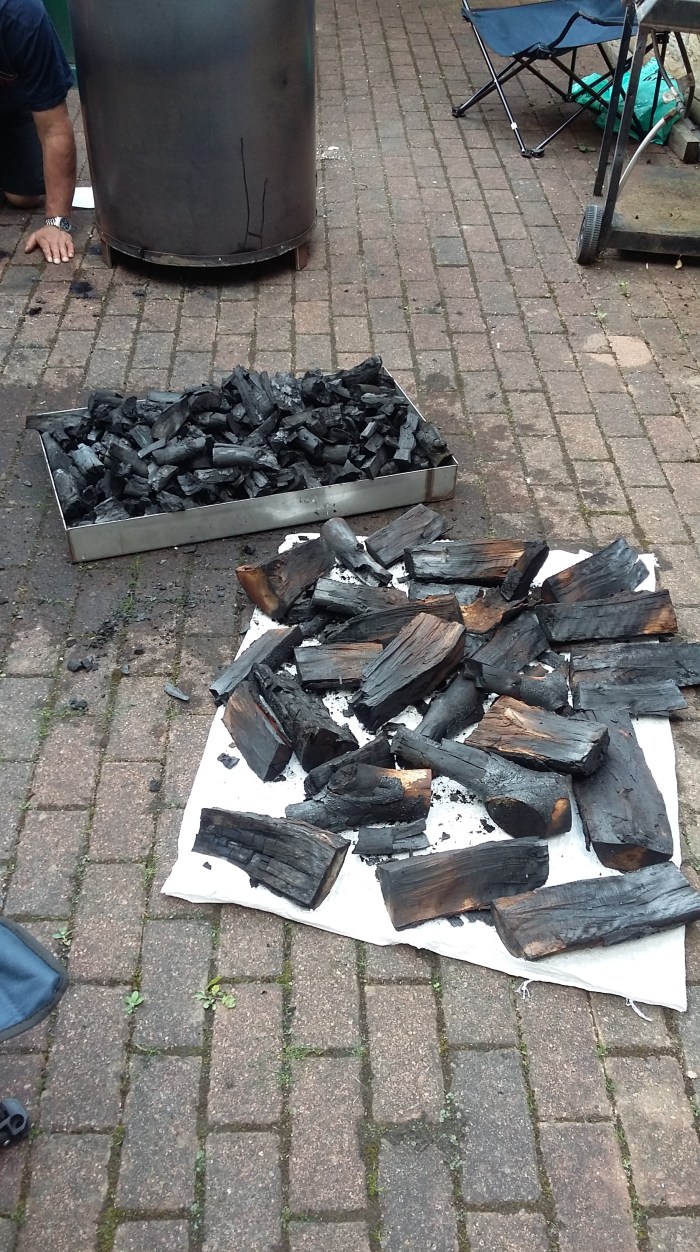
……….oh and quite a lot of brown ends where the combustion process was incomplete.
Further burns will try and refine the technique so that we can maximise the production of charcoal and minimise the amount of brown ends. That is the nature of a process I guess; where you have to work through the variables and try and determine out what works best and become a skilled operator along the way.
Disappointing to discover that there had been a forced entry into Pop’s wood during the previous week. Someone had cropped the padlock and tipped several loads of garden waste immediately inside the gate area. Of all things to fly tip I was the “lucky” recipient of several shredded giant yukka plants, still could have been asbestos I suppose. Not great to think that someone has been working out how to gain access and then illegally tip a load of waste that they have presumably been paid to dispose of professionally. These were “professional” gardeners who had bothered to shred the plant but thought that it was OK to break and enter and tip on someones else’s land.
Time to review and upgrade the security on the gate.
More next time.

 Tim Burr