Well it has cooled down a lot, so much so that the trousers are back and I wore my fleece whilst sat having my lunch on Thursday. The temperature was less than half that of this time last week! Pop’s Wood also had a drenching over the earlier part of the week. Tuesday saw a series of thunderstorms rumble through with torrential downpours as they passed overhead. This is a welcome relief for the trees and plants which were beginning to look a bit dusty and dry. The trouble with heavy rain after a long dry spell is the amount of soil that is washed away through the rivulets which quickly form on the surface. Apparently it takes quite a while for the rain to actually soak through the surface of the soil and start to add moisture to any appreciable depth. Still it did rain for most of Tuesday and Wednesday so it should have had a beneficial effect.
One of life’s real luxuries is to sit and do nothing; a challenge outlined in “Leisure” a poem by Welsh poet W.H.Davies:
- What is this life if, full of care,
- We have no time to stand and stare.
- No time to stand beneath the boughs
- And stare as long as sheep or cows.
- No time to see, when woods we pass,
- Where squirrels hide their nuts in grass.
- No time to see, in broad daylight,
- Streams full of stars, like skies at night.
- No time to turn at Beauty’s glance,
- And watch her feet, how they can dance.
- No time to wait till her mouth can
- Enrich that smile her eyes began.
- A poor life this if, full of care,
- We have no time to stand and stare.
Whilst sat in my wheelbarrow (they make excellent armchairs) having my lunch a mouse ran across in front of me and stopped to have a look before carrying on it’s way. I had caught sight of one at roughly the same spot a few days earlier but it stayed undercover, obscured by the brambles. I will sit there again and see if I can persuade him/her to have a photograph taken next time.
What I also saw and did manage to photograph were three different sorts of butterflies that were all flitting around the bramble and nettle patch next to my “dining room”.


The main picture shows a Comma which is a real eye catcher, the Comma caterpillars, I have since researched, feed on common nettles, elm and hops. Pop’s Wood can provide the first two but no sign of any hops yet.
Top right is a Large White characterised by the creamy white over lapping wings with a grey smudge at ther tips., apparently this one can be further identified as a female as it has two spots on its forewing.
Bottom right is a Ringlet with smoky brown wings. This one may be a female as the male apparently has darker wings but I am not sure how you can tell when only presented with one at a time. This butterfly only flies between June and July so a very short lived beauty.
Lovely to watch the butterflies land on a plant and slowly re-open their wings as the sun comes out and they spread themselves out to take in the warmth.
On a more business like footing – what governs how much charcoal you can make in a single burn? A simple question but given it is a physical process I guess there are a large number of variables that can affect the outcome. However perhaps an obvious and important component is it depends directly on how much “raw” wood you put in in the first place. On the last burn I set out to test this out.


The picture on the left shows how I have been loading the kiln to date. These are fairly irregular chunks of wood of various lengths and diameters tipped intothe kiln from the bags that I store them in overnight.They are then roughly positioned to fit them in but are at all angles, anywhere from horizontal to vertical. Lots of air gaps and a very “inefficient” way of packing the restricted volume. The picture on the right shows exactly the same logs but this time very deliberately packed in with all the logs placed vertically and really crammed in to fill the space. As you can see there was a lot of room left over when compared to the original fill demonstrating that the amount of wasted air space had been dramatically reduced.


The pictures above show my “armchair” with the two additional loads of wood that I was able to fit into the efficiently packed kiln. I reckon there was an increase of about 25% by volume. I was very keen to test out whether this led to more charcoal being produced as a 25% in efficiency would be quite remarkable.
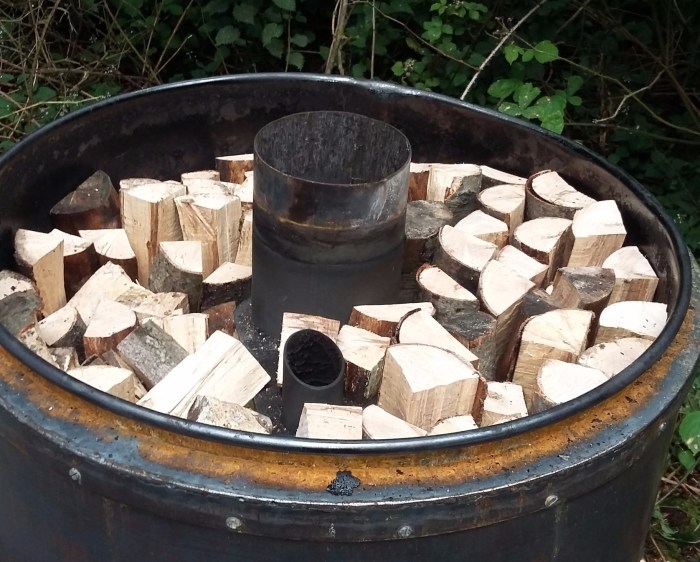
When I came to inspect the completed burn yesterday morning it was disappointing to discover that the burn had been anything but complete resulting in a large number of brown ends which took some sorting through. Some of the logs at the bottom of the kiln appeared, at their lower ends, to be virtually unscathed by the whole charring process and looked exactly as they were when they were loaded. Clearly not what I had hoped for.
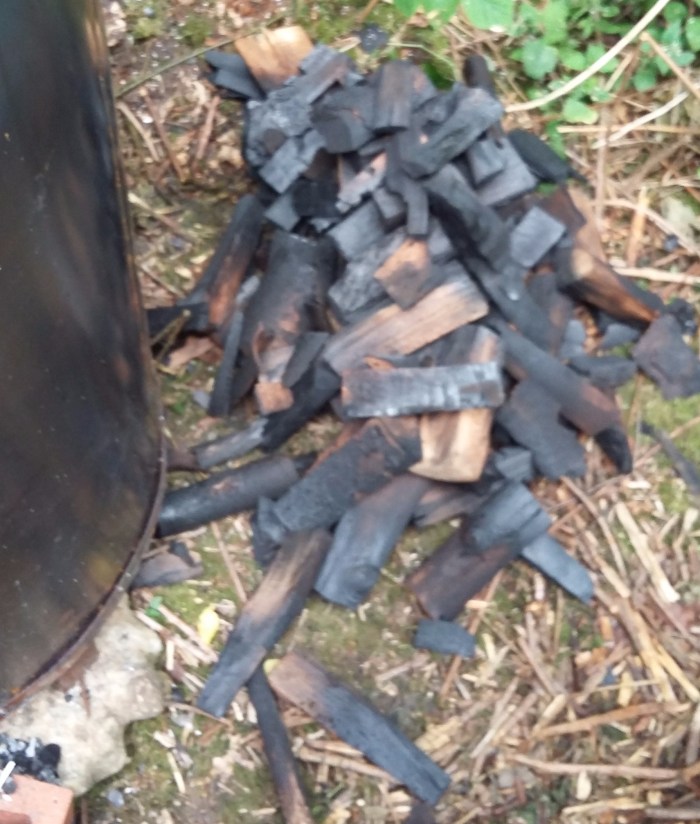
What could have happened? I had noted that during the burn itself the process never really seemed to get going. Maybe I wasn’t as attentive as I should have been to ensure that the fire didn’t drop away but kept its ferocity – this wouldn’t have helped the conversion process.
However I think that the main reason is that the air gaps present in the original inefficient loading method were actually vital to ensure that the hot air circulated around the full load driving off the moisture and the volatiles and completing the conversion. The tightly packed logs prevented this airflow and actually insulated each other from the effects of the heat transfer. So perhaps an seemingly inefficient approach is in fact more efficient over all.
Having said that I would imagine that there is an optimum load that balances the airflow and increases the overall capacity. Still a lot to learn.
More next time……

 Tim Burr