Back on the 13th May I wrote a post commenting about the brilliant colours in and around Pop’s Wood, in particular the luxurious deep blue of the bluebells set against the vivid backdrop of the yellow rapeseed flowers in an adjoining field. Both these sets of flowers have now faded and the wood and its outlook have reverted to muted shades of green. There is also less sunlight as the tree canopies have fully developed and blocked out large parts of the sky – the woodland floor is in deeper shade. It looks a lot duller to be honest, a lot less vibrant and alive than earlier in the spring.
But stop and take a closer look, lift a leaf or two and peer underneath; here is where the action is at the moment.


Wild raspberries beginning to fill out and ripen on self planted bushes scattered around the edge of the wood – these have a very pleasant sharp tangy taste to them.
Blackberries are forming as the flowers are pollinated, the bushes have a combination of some flowers and some fruit already set so plenty more to come as the season progresses.


The trees are getting in on the act with evidence of the wild cherries all around on the floor where the birds have helped themselves and dropped the half eaten fruit – that’s one of the reasons why there are so many wild cherries dotted around in the wood I guess.
The hazel trees have a lot less obvious flowering/blossom period but they have been through the cycle and the nuts are now beginning to form in small clusters – you have to be very quick off the mark to get any of these before the squirrels and dormice take them.
The sloe berries are shaping up really well and look very healthy. Bodes well for the traditional sloe gin over Christmas and New Year.


The bluebells have all gone to seed and look a shadow of their former magnificent selves. Green seed pods that are gradually drying and browning have taken the place of the iridescent blue flowers. Soon these seed pods will crack open and the seeds will get blown on the wind to hopefully form a new plant or get eaten by a passing pheasant.

The rape seed flowers have been pollinated and the seed pods have formed. These are light green at the moment and quite flexible. Later in the season they will dry out and become black and brittle. At that point they are ready to be harvested and crushed to release their bright yellow oil.
Last time I wrote about the disappointing results of my attempt to increase the volume production of the charcoal by tightly packing as many beech wood logs as possible into the kiln. This week I have continued to explore the optimum amount to pack into the retort and there have been much better results. My latest adaptation is to loosely pack in an initial layer at the bottom of the kiln. These logs are positioned “randomly” to achieve a reasonable efficiency of packing but with enough air space for the hot air to circulate. The next three layers of logs are carefully packed in side be side and positioned vertically one on top of the other until the kiln is full to the top.
The results from this approach have been positive. Previously I was taking out between 11 kg and 12 kg of charcoal after each burn. Under this latest approach I have achieved a 15 kg and a 17 kg discharge. This represents an improvement in efficiency of between 25% at a minimum and 55% at a maximum. Not bad for simply paying a little more attention to the way that the process is managed.
Snap shots below showing the dramatic reduction in the amount of brown ends before and after:


Finally it is easy to get spooked in the wood sometimes with all the strange noises. I was startled yesterday by two birds erupting into an almighty argument at the tops of their voices and flying repeatedly around pecking at each other in the midst of a nearby blackthorn. After a few frenzied minutes one of the birds “won” and all was quiet again. Who were these aggressive combatants?
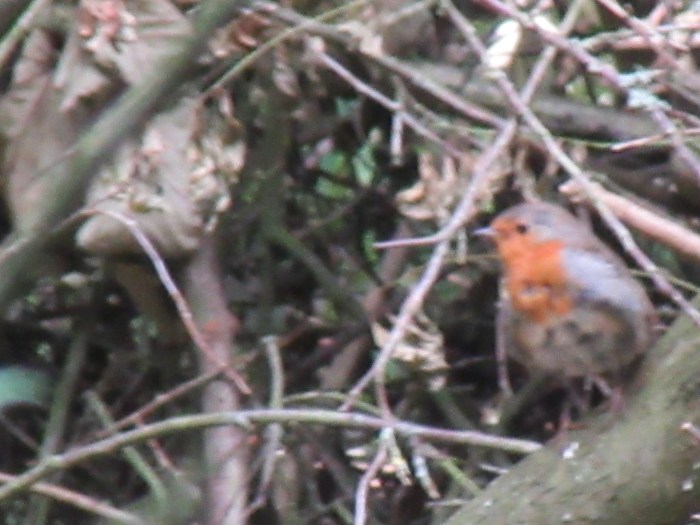
Robins! The photograph was taken with the zoom lens at some distance so not very sharply focused but is that damage to its red breast feathers that can be seen? Was this as a result of the fight? I had previously understood that robins were very fiercely territorial but never witnessed it at first hand until now.
More next time…….

 Tim Burr