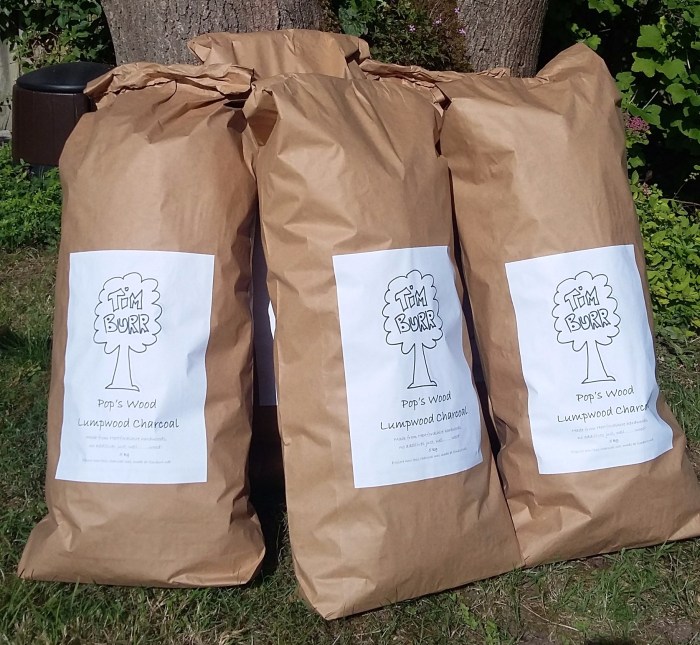
Last Sunday was the local village fete and on a last minute whim I had decided to take a stall to try and promote/sell some of the lump wood charcoal and raise awareness of the firewood and biochar.
We were very lucky with the weather and had a glorious sunny Sunday afternoon and a good crowd. I was very pleased with the level of attention that the stall attracted, lots of people were interested to understand how the charcoal was made and seemed genuinely fascinated by the process and I was able to sell some of the bags. Funny how we all tend to take so many products that we buy for granted without questioning how things are made any more. That’s the great thing about craft stalls, they remind us how things used to be made. I suppose at some stage we used to not only know how things were made but also the local person who made them. It seems that there is an opportunity to re-start making some of what we use with all the advantages that that process brings.
Ninety percent (90%) of the UK’s charcoal is imported from either South Africa or South America. If we assume that this charcoal is produced in each of those countries at the very nearest point to the UK that means that the imported charcoal has travelled a minimum of 1,100 or 4,000 miles respectively. By a quick comparison the total journey miles for Tim Burr’s lumpwood charcoal is 25 miles. So there has to be a case for buying and using local charcoal – saving the planet one BBQ at a time!
Here is a rather pleasing clip of a piece of Tim Burr charcoal being dropped and the lovely, almost metallic, sound that it makes. Audible evidence that it has been thoroughly hard charred to drive off the other impurities.
I was in Pop’s Wood yesterday and had a walk around some of those bits of the wood that I don’t ordinarily pass through. I walked past a fallen ash that must have collapsed before I bought the wood. It is clearly dead but hasn’t quite reached the ground as it fell against an adjacent spruce and is still leaning heavily against that tree.
What I noticed this time around is the abundance of King Alfred’s cakes that are growing on its sloping trunk.
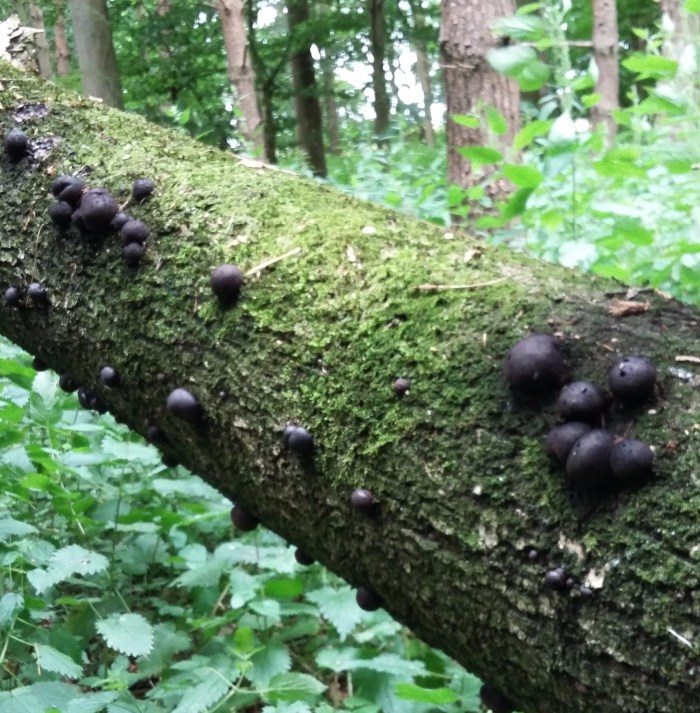
King Alfred’s cakes are named after the legend of King Alfred being distracted during a baking session and overcooking the buns. They are also sometimes known as Cramp Balls as carrying them was thought to be a cure for cramp. They are a fungi and are usually found on dead ash trees although they can grow on beech as well. When cut open you can clearly see growth rings as they put down an discrete layer as they grow on a seasonal basis – so the larger they are the older they are. King Alfred’s cakes can be very useful for lighting fires because the inner flesh, once dried out, can be easily lit by catching a spark from a “firesteel”(this is an “artificial flint” which creates a spark for starting fires, much used in bushcraft). The spark ignites the flesh of the fungus and, in true Ray Mears style, will respond to being gently blown and although it burns slowly like a barbecue briquette, once it has been lit it is possible to transfer the glowing part to a ball of tinder and get a flame started. Must try this and try and make a video for another time.

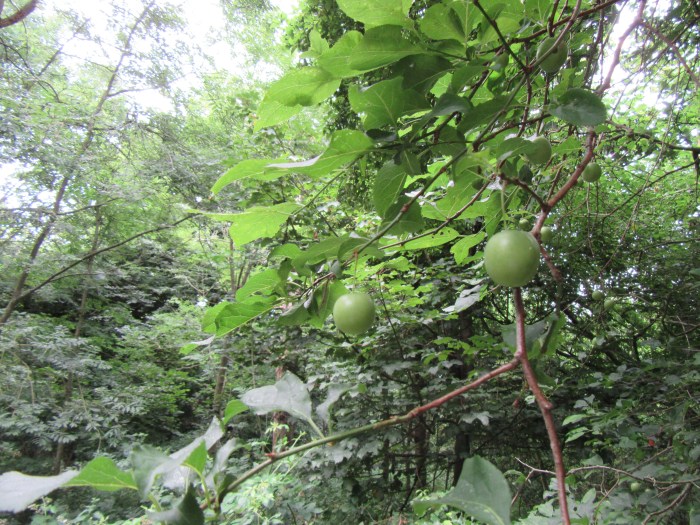
I must offer an apology and a correction to last week’s post. What I thought was a blackthorn bush is in fact a crab apple! The picture of the fruit that I posted last week and talked about there being a bumper sloe berry crop is in fact a crab apple. Whoops.
Apparently the fruits are not that attractive to browsing animals, they will ripen, fall and only when they start to rot will the deer and rabbits have a go at eating them. They are a very hard, very tough and sour fruit but can be turned into a delicious jelly simply with the addition of a huge amount of sugar. The timber is very hard and closely grained which makes it useful for wood carving and turning. It also makes excellent firewood which I had already picked up on as I have been using some of the dead branches to stoke the charcoal kiln. Here is a repeat of the picture from last week but this time with an accurate caption.
More next time……..

 Tim Burr