A sombre week this week.
Ash-die-back is a serious threat to all ash trees in the UK. It was first confirmed in Britain in 2012, Chalara dieback of ash, also known as ‘Chalara’, ash dieback or Chalara ash dieback, is a disease of ash trees caused by a fungus called Hymenoscyphus fraxineus. It is fatal for the tree.
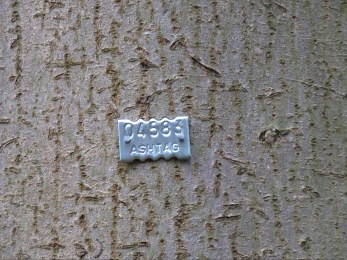
In the Autumn last year I enrolled with a project called AshTag. AshTag was developed by Adapt and the University of East Anglia in 2012 and transferred to the Sylva Foundation in 2015 and has worked under the Defra-funded Living Ash Project (www.livingashproject.org.uk).
The idea is that woodland owners from around the UK register a number their trees with the AshTag initiative and open up access to monitor their progress against the influx of the ash die-back disease. This initially involves nailing a tag to a tree and sending in photographs and GPS references for that tree to the AshTag site. I did this back in November 2016 and this week I received a visit from two tree specialists Jo and Steve. They are currently on a tour visiting various sites across the south of England monitoring the extent of the disease.
The bad news is that some of the ash trees in Pop’s Wood have got ash die-back disease. Jo quickly identified my first ash tagged tree to be suffering and pointed out its very thin canopy and branching of intermediate buds along a horizontal branch a feature that is not natural in ash trees. This latter effect is an attempt by the tree to grow more leaves and so maintain its growth. There is apparently nothing practical that can be done to prevent the progress of this disease other than rely on nature. Nature has an incredible ability to generate variations in trees some of which will develop a natural resistance to the disease through the process of natural selection.
There is a small copse of a perhaps a hundred or so self planted ash saplings in Pop’s Wood that could prove to be of interest to the project. There are signs that some of these saplings have already been infected by ash die-back. The fungal infection enters the branch through the leave stem and makes its way along the branch into the trunk of the tree. The picture below shows the tell tale diamond shaped scar lesion left where the fungal infection enters the main trunk. However, some of the saplings are healthy and the intention is to refrain from any management intervention but to leave the saplings to “fight it out” over the next few seasons and see which ones continue to thrive.
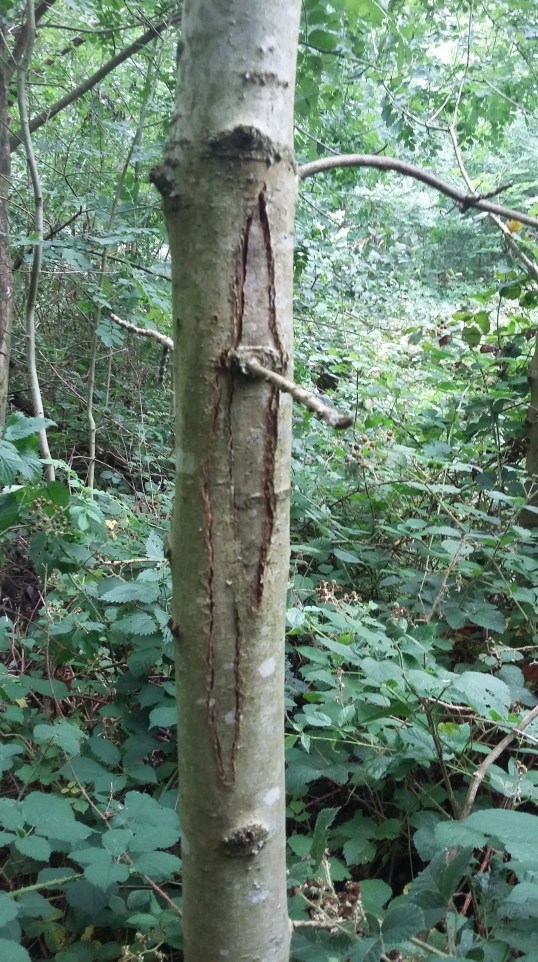
The main picture at the head of the blog shows evidence of die-back ie where the leaves on a seemingly healthy sapling have shrivelled up and are set to drop. These have been infected by the fungus and will drop to the floor where the fungus will continue to feed and grow. At this stage next year the fungus will be ready to spore and these spores will be blown onto new leaves reinforcing the infection throughout the tree and neighbouring trees.
I was told that there is no real action to take other than if I was planning to use a particular ash tree for timber then I would be advised to fell these over the next 2-3 years as the fungal infection can stain the normally white timber and ruin its resale value. Its value as firewood remains unchanged which is a good fall back option.
So the plan for the project is for woodland owners to continue to monitor the progress of their trees and for the project to revisit in say 2 -3 years time to check on whether any trees are continuing to remain unaffected. There will then be a more active phase where formal propagation of new plants from these trees will be undertaken to establish a resilient successor population of ash trees. A real waiting game.
Just to add to the gloomy picture there is also evidence of canker on some of the small saplings. Canker damage looks like the tree has burst open at the point of infection.
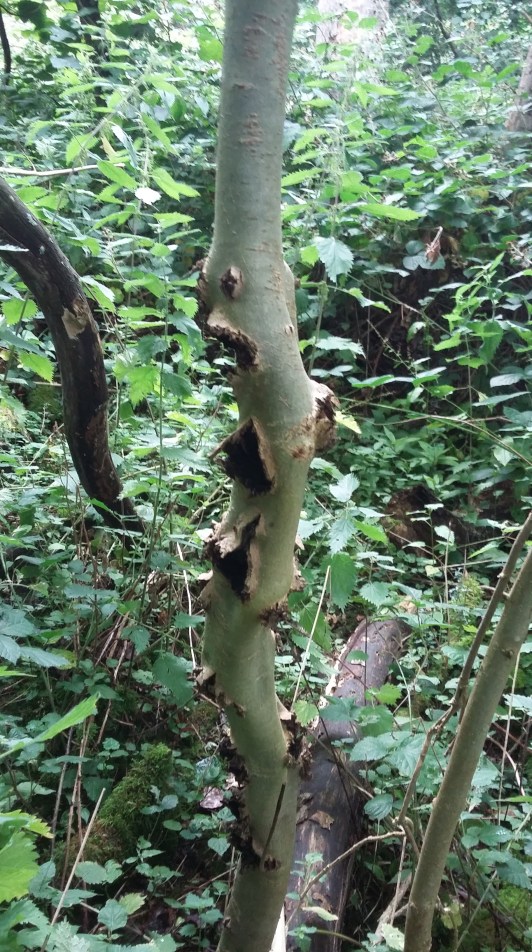
It is generally due to infection by the fungal pathogen Nectria galligena. Doesn’t look great and the tree will struggle to recover. But as these are in amongst the ash die back saplings I will leave them to struggle on at this stage and rely on the survival of the fittest to sort out which will survive to maturity.
More next time………

 Tim Burr