Tree identification can be very difficult in winter when all you are presented with is a bare silhouette of the branches and the bark of the stem to consider. The task becomes slightly easier in spring when the leaves form and certainly by the time the fruit or seeds have emerged then it should be relatively straight forward.
Well. I have had three goes at identifying one particular set of trees/shrubs in Pop’s Wood and have got it wrong on the first two occasions. At the first attempt I identified the mystery tree to be a blackthorn and was looking forward to picking the sloes in autumn and making some sloe gin. When the fruit appeared they were a lot bigger than I excepted and strangely the wrong colour. This didn’t put me off though and I dismissed the size and colour discrepancies and celebrated the fact that they were huge sloes.
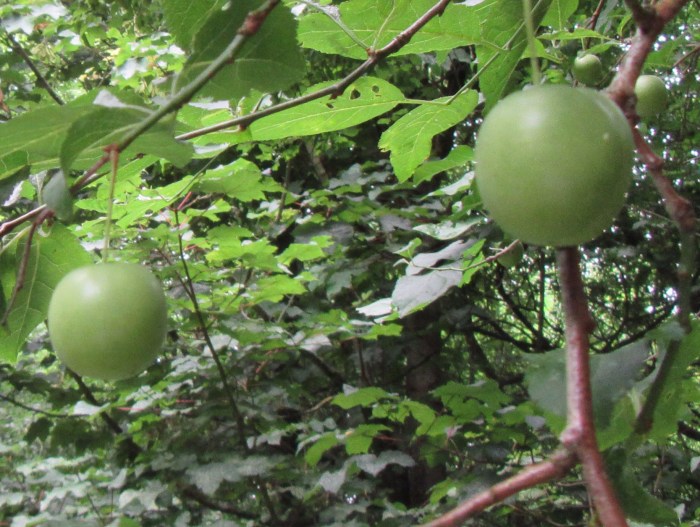
Closer scrutiny and a more sober look at the crop made me have second thoughts and having consulted the text books I realised my mistake and so at the second attempt very confidently identified the tree as being a crab apple. The size and colour of the fruit made it unmistakable. How silly of me to think that is was a blackthorn. This was good news as the wood from a crab apple is good for firewood and is suitable for carving.
The fruit on the “crab apple tree” matured and ripened over the next few weeks to a gorgeous deep, well….. plum colour and were soon ready for harvesting. The tree has sprawled over the years and so is quite close to the ground and it was easy to clamber in amongst the low lying branches and pick a huge bag of crab apples. At home we have a book called “A year in a bottle” which details various fruit that you can preserve as they ripen and store for use later throughout the year. There was the usual crab apple jelly and jam recipes but also a really nice sounding way of making a crab apple lemonade which only took a week or so to ferment. I assembled the ingredients, carefully washed the crab apples and then started to remove the stones from their centre. Hold on a minute – crab apples don’t have stones in them. Back to the “A foolproof guide to identifying trees” hand book!

It turns out that the crab apples were a lovely plum colour because they are in fact lovely cherry plums. In a way that is better than crab apples as they are a lot more edible.
So this week I have mainly been eating stewed plums and custard. I guess that that is it as far as the identification of this particular tree goes. They say that the proof of the pudding is in the eating and that process turned out to provide the absolute fool proof evidence in this case. Not so sure that approach would work so well with mushrooms.
More next time.

 Tim Burr