How does wood dry when the relative humidity in the wood is 75% at the lowest? Confusing to think that the stack of firewood that I have chopped will air dry in the open air to about 14% to 20% moisture content yet be sat in an atmosphere that has a relative humidity of 75% at the lowest. Yet the drying process has already started with the moisture meter showing that the logs have dropped from in excess of 40% moisture level to around 30%. At 100% humidity chopped wood will never dry. Temperature does affect drying speed, but even at -20C it will get dry eventually.
Drying times will decrease as air humidity decreases, and as air temperature increases. However, the process is not entirely reliant on temperature and in fact the speed of the drying process seems to depend on a number of factors. If the air is warm and dry, but there’s no wind, clothes dry slower than if it’s colder but there is a wind. The wind is therefore important. Air circulating past the wood allows water from the atmosphere to drop out onto the wood but also drives the evaporation process which takes water from the wood and transfers it to the passing air. Although the average relative humidity seems high at around 70 – 80%, as long as it is below 100% there is room for more water to be transferred to it and so objects will dry. The lower the humidity number and the higher the temperature then the quicker the process will be as long as there is a wind to create a movement of air past the stack of wood to allow fresher air to take part in the process. To exaggerate this point if I were to stack a pile of logs in an airtight box with a glass lid and leave it out in bright sunlight then I would have a very high temperature but because there is nowhere for the water to go once the trapped air reaches a 100% then the wood would not dry out. Simples.
On more straightforward matters I realised when I wanted to use it that I had not replaced the shaft of my fro following me breaking the manufactured beech one a little while ago. Bit annoying really as I wanted to use the fro to split some hazel rods to make the next rain shelter for the drying logs. As an aside a fro is the origin of the phrase “to and fro”; the tool is designed to be rocked along a split in a grain of wood to encourage the wood to split evenly along its length,
No problem – why not make a new handle out of a lump of beech from the very tree that I was stood under. Pictures below show that process……


……..and it worked a treat.
Just when you thought you understood the mechanism for wood splitting along the grain and in straight lines an odd thing happens.
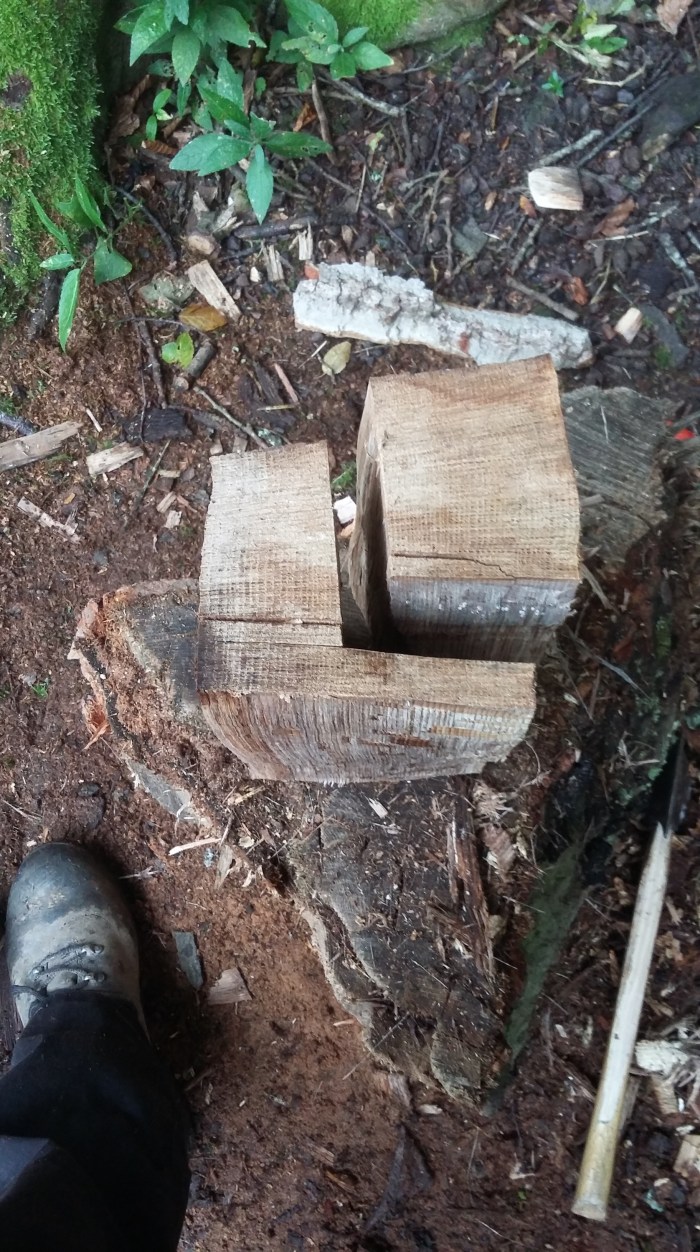
Very odd. More next time.

 Tim Burr