I mentioned a few weeks ago that the wind had brought down a part of a dead beech tree, well this week I spent a day on that beech clearing up the fallen wood. There is a great value to having dead wood and standing dead wood in particular in a woodland.
The Forestry Commission state that “Deadwood supports a large and complex food chain and is an essential element of any sustainably managed woodland. Decaying wood
produces humid, protected niches for invertebrates, plants and fungi
which in turn help form the woodland soil and directly support other plant,
bird and animal populations. Many of the species reliant on deadwood
are now rare or endangered.”
What should I do with the fallen branches? Do I have to leave everything that falls to rot away on the floor? Again reference to the Forestry Commission web site indicates that a 5% volume of dead wood is a suitable rule of thumb target for a healthy woodland. This equates to 1 in every 20 stems will be a either a dead stem or contain a significant amount of dead wood. Using these guidelines and on the basis that I am trying to make the woodland work from a financial perspective,I have determined that I should use the fallen timber but leave the remains of the standing dead beech and simply work around it.


As can bee seen from the pictures above there was a significant volume of timber to be recovered. My intention for the smaller diameter wood is to process it to charcoal using some of the scrub branches as fuel to fire the whole process. The advantage of the beech having been dead for a while is that the wood is fully seasoned and has a very low water content.
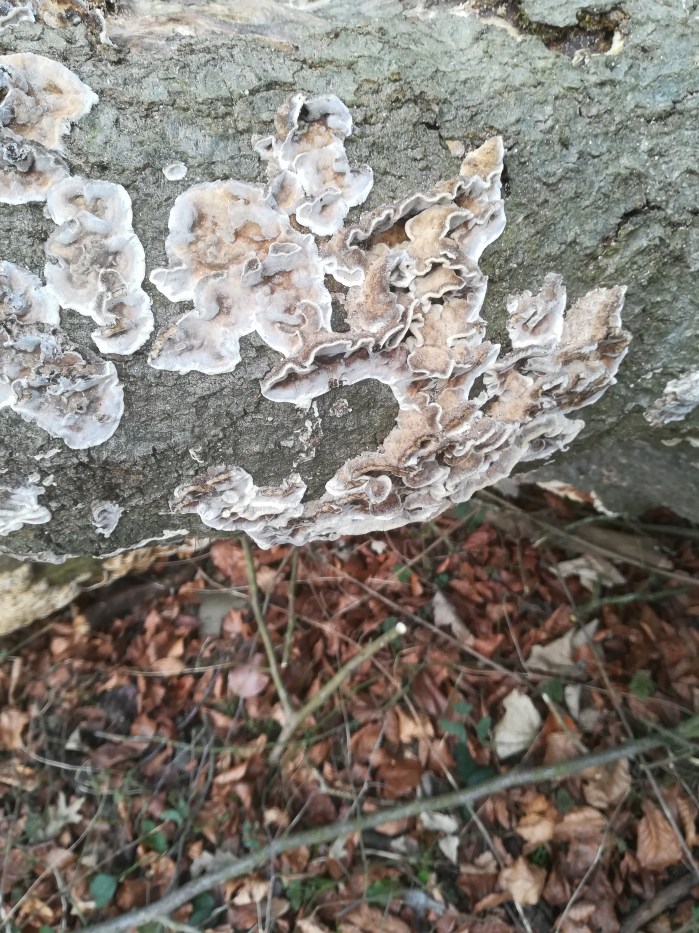
A lot of the bark of the tree was covered in a fungal infection as shown above. Not sure what sort of fungus this is but will do some more homework and try and find out.
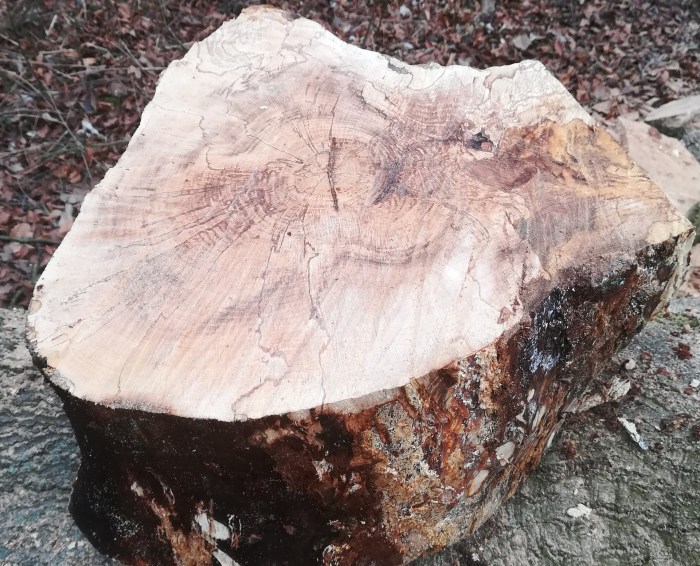
The upshot of this and other fungal infections is that the grain within the felled tree has taken on a significant and attractive transformation. This process is known as SPALTING and is highly valued amongst wood turners and cabinet makers. The main picture shows a small section that I recovered with a view to making a turned wooden bowl.
Here is a another close up of that same piece of wood.
Turns out there is a massive amount of great deal of variety of spalting processes involving different species of fungi and the order in which they attack the host tree. Here are a few of the main varieties:
- White rot – the mottled white pockets and bleaching effect seen in spalted wood is due to white rot fungi. Primarily found on hardwoods, these fungi ‘bleach’ by consuming lignin which is the slightly pigmented area of a wood cell wall. Some white rotting can also be caused by an effect similar to pigmentation, in which the white filaments of a fungus, such Trametes Versicolour is so concentrated in an area that a visual effect is created. Both strength and weight loss occur with white rot decay.
- Brown rots, the ‘unpleasing’ type of spalting, do not degrade lignin, thus creating a crumbly, cracked surface which cannot be stabilized.
- Both types of rot, if left uncontrolled, will turn wood useless.
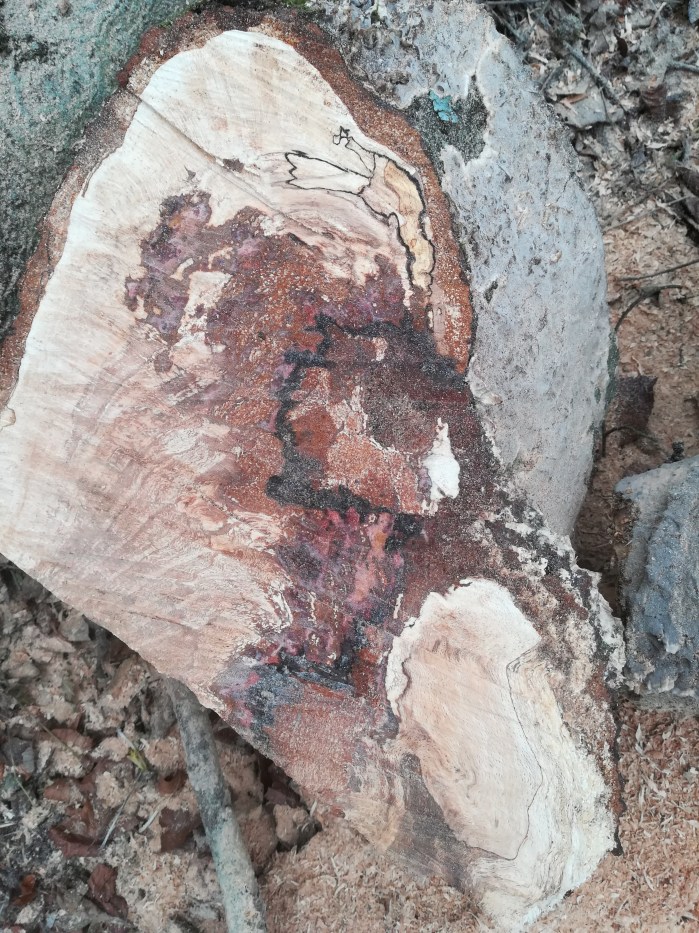
- Zone lines (looks my examples have these) are dark dotted, winding lines and thin streaks of red, brown and black. This type of spalting does not occur due to any specific type of fungus, but is instead an interaction zone in which different fungi have erected barriers to protect their resources.They can also be caused by a single fungus delineating itself. The lines are often clumps of hard, dark filaments. Zone lines themselves do not damage the wood. However, the fungi responsible for creating them often do.
Who knew!
The beauty of what you discover in nature is primarily to be marvelled at with the understanding of how/why it occurred coming a close second.
More next time…………

 Tim Burr