In December 2016 I coppiced two hazel trees, these were my first attempt at this important aspect of woodland management. Like all new ventures there is a certain faith in the training and the theory that you have been taught but at the back of your mind is a nagging doubt that it could all go horribly wrong.
These hazel trees had previously been coppiced but had not been managed for twenty years or so. Having said that the stools were healthy and had vigorous growth. The most obvious sign of lack of management is the enormous variety in thicknesses of stems. Some had a diameter of 6″ with others the classic bean pole or whip diameter.

It is physically quite hard going to saw through the various stems as access is often restricted. Hazel is a relatively soft wood but cutting any standing tree has the dynamic elements of the weight of the branches either squeezing the cuts closed or breaking open unpredictably. I found that taking the branches down in stages helped ie taking the majority of the branch down and taking the weight off the stool allowed the close up work to be done under more controlled conditions. It is important not to damage the stool, by perhaps the branches ripping away as they are partially cut, as the stool is the engine room of the regrowth.


During the cutting process its important to identify a number of healthy stems and select them for layering. This is a process whereby the stem is partially cut near to the stool and bent over and pinned to the surrounding soil. Prior to pinning the bark is scratched off the side that is in the soil to encourage the growth of new roots. Hazel has the ability to put down roots and generate new stems along these layered lengths and so eventually propagate a whole series of new stools that can be separated from the “parent” and establish themselves as new independent stools.
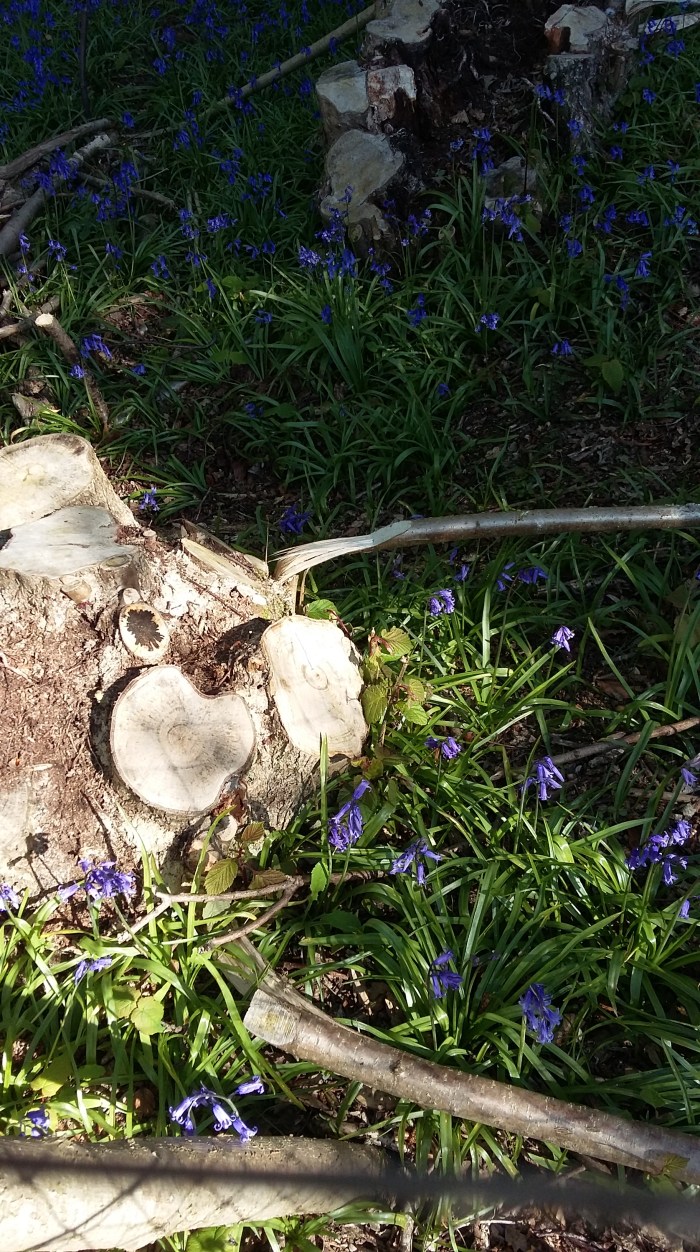
At this stage you hope that you haven’t hacked away too much and that your enthusiastic but amateur efforts will not prevent mother nature recovering and regrowth starting.
I am happy to say that approximately 15 months later the stools are once again flourishing.


Did the layering work? Well here is a short video tracing one of the layered stems and the prolific regrowth that has followed.
Safe to say that I had to protect fence off the coppiced stools in a small compound to protect the new shoots from the nibbling deers; but this effort would seem to have been worthwhile. This was a small scale trial venture into the world of coppicing but it has given me confidence in the process and my approach to scale up this next autumn and tackle a larger number/area at the bottom of the wood adjacent to where the turkey oak came down. This is when the woodland starts to change and be brought back into management. Sounds draconian but hazel coppicing encourages a wide range of habitats for butterflies, dormice, reptiles other birds.
More next time

 Tim Burr