Superficially flints have nothing to do with wood or trees….or do they? I guess one connection is that they are an indication of the soil that is in your woodland and so what trees like growing there. Flints occur in chalky or limestone areas. The soil in Pop’s Wood is predominately chalky/clay with a rich leaf litter which has been deposited over years. There are instances where there are subtly raised banks which may have served as wall footings ie boundaries. There is a high concentration of flints in these locations as the original “builders” of the footings would have gathered together whatever materials were close to hand.
Flints are curious. I am not sure that I fully understand the chemistry but flint is apparently a sedimentary cryptocrystalline form of the mineral quartz. Diamonds are also a form of cryptocrystalline structure. I take from this that flints are made up of minute crystals closely packed into a dense structure giving it great strength.
Some of the flints that you find on or just near the surface of the ground have distinct nodular shapes. These were formed when minute crystals of quartz settled into the empty burrow of an animal or insect millions of years ago and took on the shape of their surroundings.


Of course it is the properties of flint that would have been of most importance to those living in the ancient woodlands. Flint can be sheared or knapped to produce very sharp shards or to produce a cutting edge.
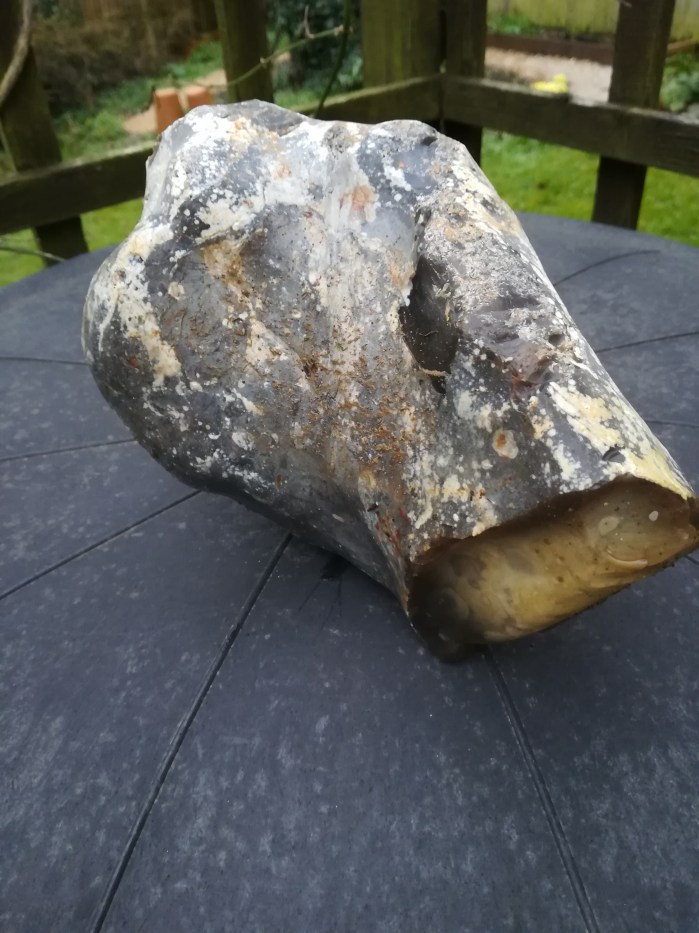 It is not difficult to imagine an axe being produced by knapping a block such as that above. That axe could then be used to shape fallen branches or even to cut down trees. The razor sharp shards were used to butcher animals and to process the skin and fur into usable clothing. Much later the discovery that red hot sparks are produced when a flint is struck by steel would have made the flint a valuable resource to carry around enabling fires to be started at will. Flints have also been used an incredibly durable building material and can be seen in many rural buildings.
The connections between the woodland and the flint didn’t seem immediately obvious but they go back a long way together and flint has almost certainly helped shape the woodlands that we have now inherited.
More next time……………..

 Tim Burr