The rainfall on Friday evening last week has helped freshen up the woodland plants a little, but as the temperatures are still 25ºC+ every day some of them are still struggling. That is apart from the nettles. Nettles would survive a direct hit by a nuclear weapon I think, they are amazingly resilient and in fact seem to be thriving under the current conditions. Certainly a combination of nettles that are growing like topsy and wearing shorts to combat the heat leaves a lasting impression throughout the evening after a day in the wood.
Earlier in the week I prepared and then loaded the retort with a charge of hazel logs. These were slightly easier to saw and prepare than the beech but I seemed only to be able to fit in four of the crates as opposed to four and a half of the beech logs. I don’t know whether this is just a one off but clearly the less you put in the less charcoal you get out.


When I went back up on Friday to unload the finished burn I had trouble getting the lid off. This is not new as usually I have to twist the top to free it from the chimney that pushes through the centre of the lid. However, when I lifted the cover I noticed that there was a very slight dusting of ash on the charcoal which is something that I haven’t seen before. It was not until I started to unload the charcoal that I noticed the issue. The chimney, which is also contains the fire, had weakened to the extent that my exertions in twisting the top had “ripped” the pipe apart. My guess is that there were some smaller holes that had formed prior to the final burn and that some air had been introduced resulting in some of the charcoal burning and making the ash deposit. Thankfully this was only a very slight effect as the vast majority of the load was intact and looked perfectly sound.


The chimney was originally a bus exhaust pipe but in the retort has been exposed to some very hot temperatures and clearly has suffered from the treatment. It looks as if it is fixable, subject to what my big brother says, and so we will be back up and running very soon. One of the jobs is to have a look at the design and the materials used for the chimney:
- Could it be a little thicker walled? The issue here is that the thicker walls may well impair the heat transfer across into the retort.
- Use a more resistant metal such as stainless steel? Costs could be prohibitive and it is not easy to work with in terms of cutting and welding.
- Replace with like for like recognising that it will fail after a while so ensure that it is easy to replace.
The good news is that the hazel performed well in the retort and if anything was slightly livelier than the beech with a flame shooting 3′ out of the chimney during the wood gas phase.
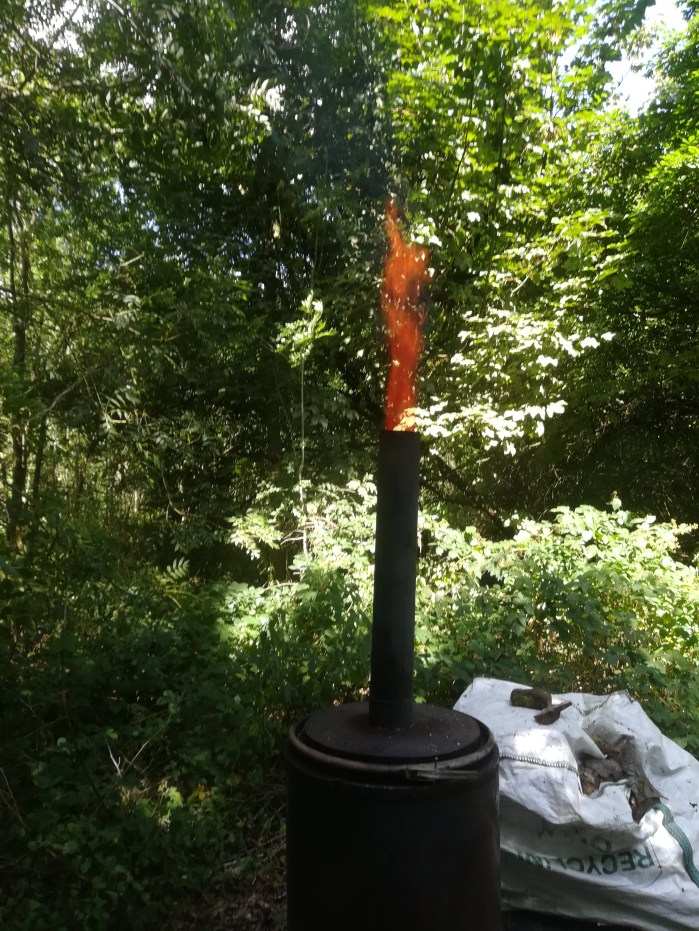
The yield was slightly down in that there was just over 10kg produced as opposed to the usual 12kg. This may be simply down to loading less at the outset.
The weather broke on Friday with a series of thunderstorms and some very welcome rain. What was slight less welcome was the strong winds that grew as the weekend went on. A victim of this was the tarpaulin canopy that is suspended from one of the beech trees at the top of the wood. The manufacturers always seem to rely on eyelets at the corners that are sewn in and from experience don’t last the rigours of an outside life for very long.
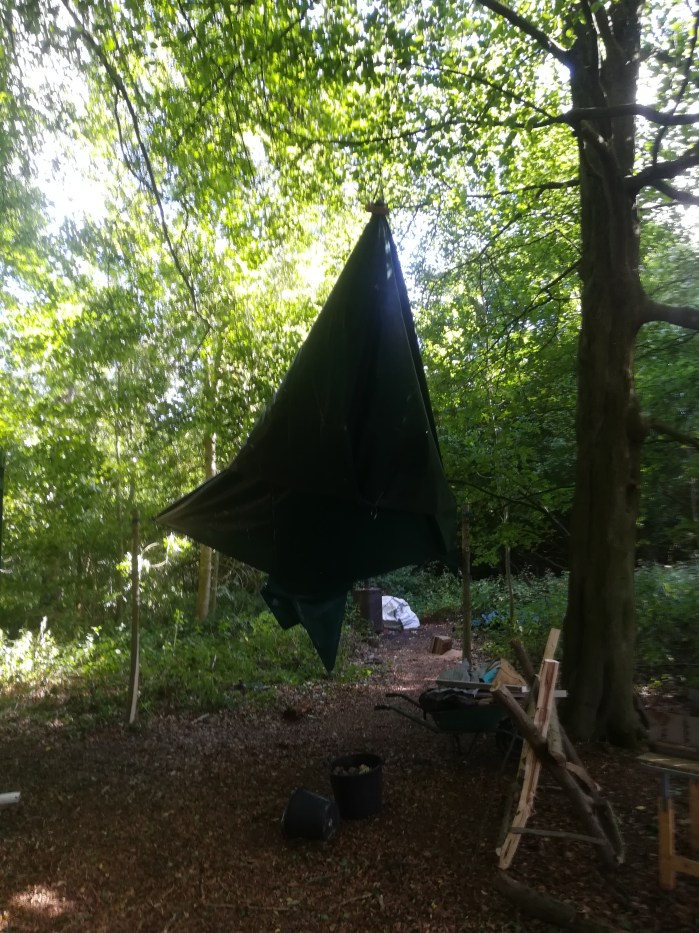
Simple repair was to tie a knot in the remaining material at the corner, tighten a cable tie behind that knot and thread a second cable tie through the first just before the former was fully locked in place. That way the guy rope could be re-attached through the loose cable tie and the awning restored.


More next time………………………

 Tim Burr