During the recent strong winds there have been a few casualties in Pop’s Wood. If there are any weaknesses in the trees then the wind is pretty ruthless at finding them out and bringing them down. I guess that isn’t necessarily a bad thing. The tree had a problem and although the wind is a very crude form of tree surgery, nevertheless, the weaker limb is now down and the tree is less vulnerable. The problem is that the falling limbs, it seems, rarely come down on their own but often take out branches from neighbouring and otherwise healthy trees. So it has been for a couple of more serious fallers this last month.
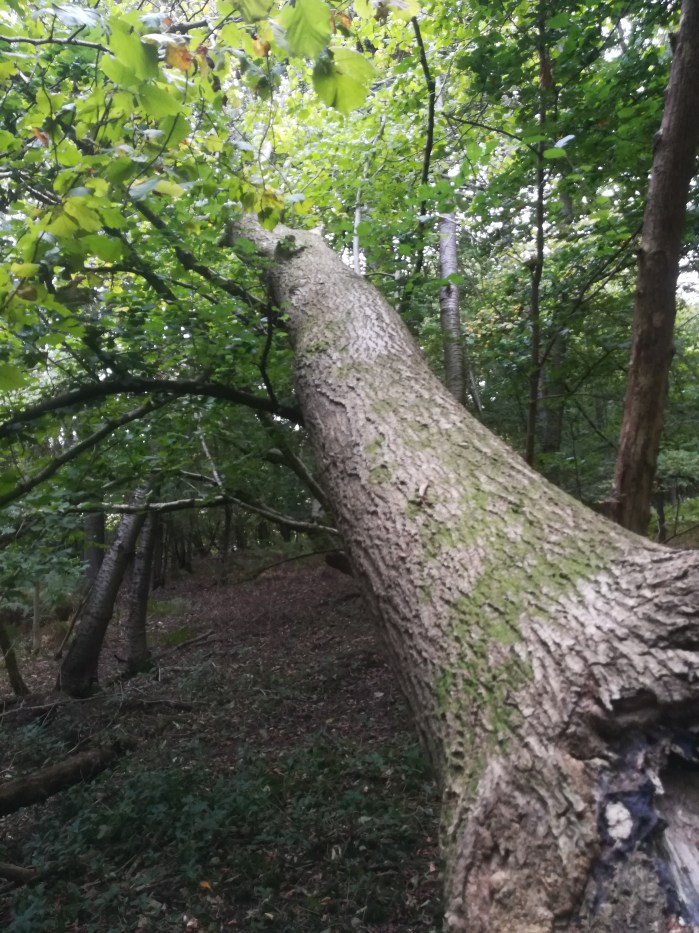
This is one of the trunks of a two stemmed mature ash tree. As can be seen the base of the trunk has rotted away and become unable to support its own huge weight. The strong winds has done the rest! In this case the tree has fallen onto several other trees. The top canopy is hung up on a large turkey oak , with the rest of the trunk coming down on top of several wild cherries and some of the hazel that I intend to coppice later in the autumn. The picture shows two of the wild cherries (wild – they’re absolutely furious!) leaning into the fallen tree. These have been caught by the trunk as it fell and have been pulled over, on one the roots have started to lift out of the ground. So not only has this tree potentially damaged a few others on its way down but it is far from safe in its current position.
Trees that become hung up on their way down are more difficult to tackle than felling a tree that is standing straight up. The tree in its standing position is a known quantity, judgements can be made about the best direction for it to fall and a cut chosen to best facilitate that plan. Unfortunately if the tree becomes stuck on its way down then all bets are off. It is very difficult to know how secure it is ie is it delicately balanced and will the slightest intervention bring it tumbling down or is it absolutely stuck fast? To add to the complications the broken end is about three foot off the floor and still (loosely) attached to the main tree base.
I think in this instance it would be sensible to put a winch onto the broken end of the trunk and try and pull that end free of the stump and down onto solid ground. Once that is achieved then it may become more obvious what to do with the top end. The advantage of using a winch is that you can apply the pull (in this instance) whilst being well away from the danger area. Unfortunately the initial pull is unlikely to solve the issue but at least having one end firmly on the ground will make it potentially easier to attach the winch higher up the trunk and attempt to pull the rest of it down. I am not too concerned about the damage to the cherries as these are planned to be removed to allow more light into the first coppice coupe. Equally the hazel is intended to be coppiced in a few weeks so any damage to the hazel branches is not critical as long as the stool remains intact. However I am keen to minimise any damage to the turkey oak and will have to work carefully around it.
The ash itself will be worth trying to get down in as big a piece as possible. The trunk is reasonably straight and may well be able to be milled for timber.
Whilst tidying up another fallen ash limb that had taken several beech branches down with it I noticed one of the beech branches was a peculiar shape.
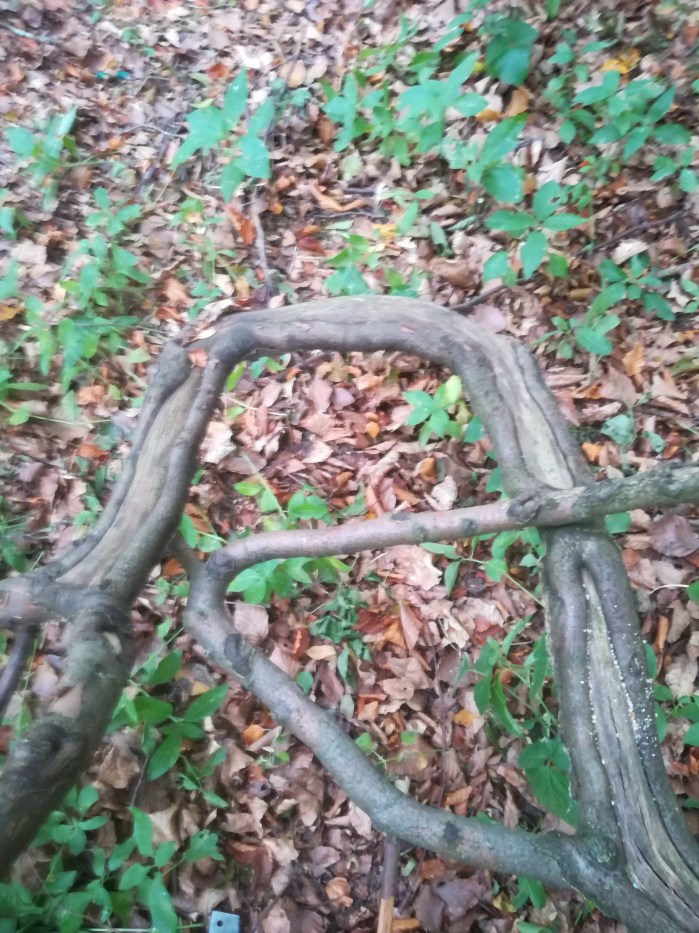
Goodness knows why the branch has grown in this convoluted way but very satisfying to come across a bit of “art” in the wreckage.
More on this next week.

 Tim Burr