Having cut up the various trees that were affected by the collapsed ash tree, there is now a need to move the logs up to the top of the hill. Here there is a log store awaiting milling into planks. Also given that the lower area is about to become a hazel coppice/plantation there will be limited opportunities for clearing the logs later in the process. So the idea will be to complete the coppicing of the existing hazel trees and then fell the larger trees that are selected to be removed to reduce the canopy cover and let the sunlight reach the coppice stools so encouraging new growth. Each of these felled trees will be logged into say 6′ to 8′ lengths and then processed for timber by milling them into planks.
All that said leads to the need for a reasonably efficient method of moving the quite substantial logs from the bottom of the wood up the hill to the log store at the top of the wood. Oh if it was only the other way around and gravity could do most of the work!
Just over a year ago my brother visited the wood and when he got home he designed and built a prototype log carrier. My main criteria was that I wanted to minimise the physical impact that the log carrier had on the woodland itself. I was and still am not keen on having a lot of rides carved into the wood. I think that these can detrimentally change the character of the wood and also lead to an increased security risk as all felled timber has a ready route out of the woodland. I guess also I am not keen to spend all my working time in the woodland with ear defenders on and breathing in 2 stroke fumes.
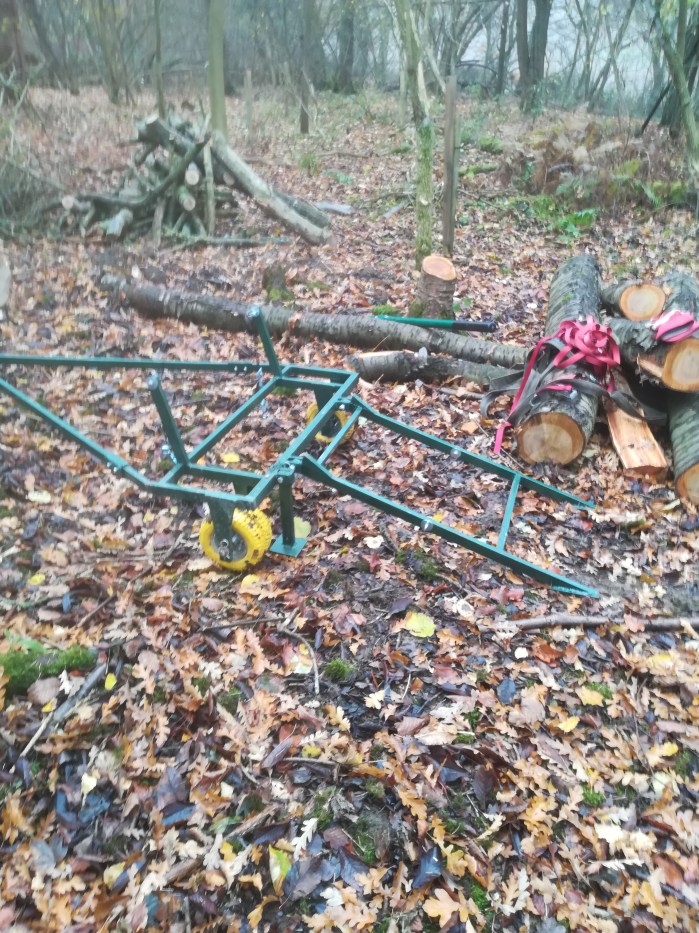
This is a great design. There is a hinged ramp at the back with a winch and cable at the front for dragging the logs up the ramp onto the carrier. the main load is carried directly above the rear axles and the wheels are puncture proof. The first task the is to drag up the first log.
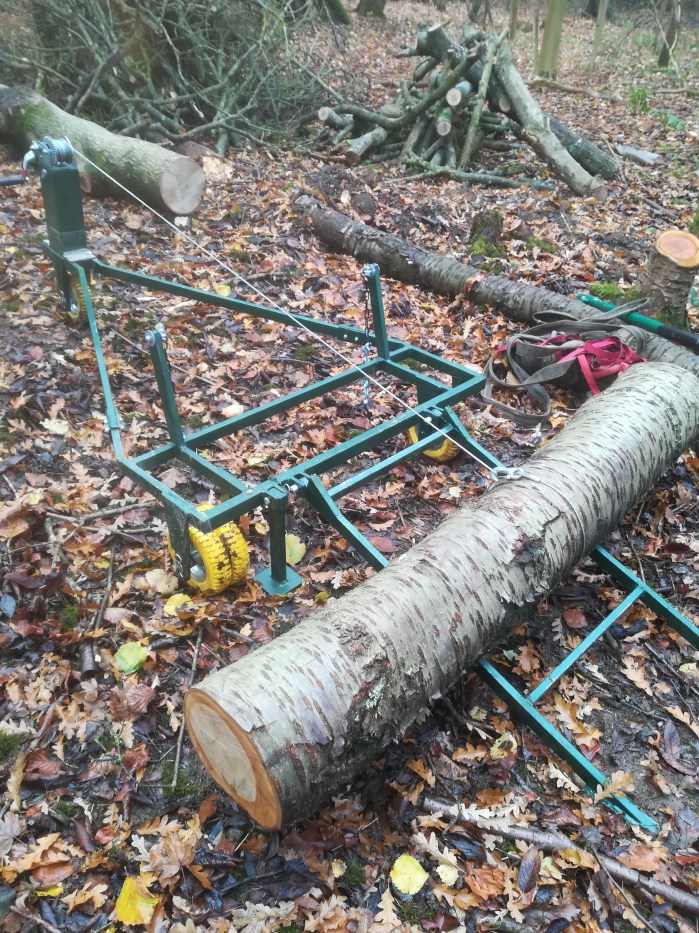
The winch made short work of hauling the log up. The second and third logs followed suit.
Seemed sensible to try and maximise the load on the carrier and manage to take three logs up at the same time.
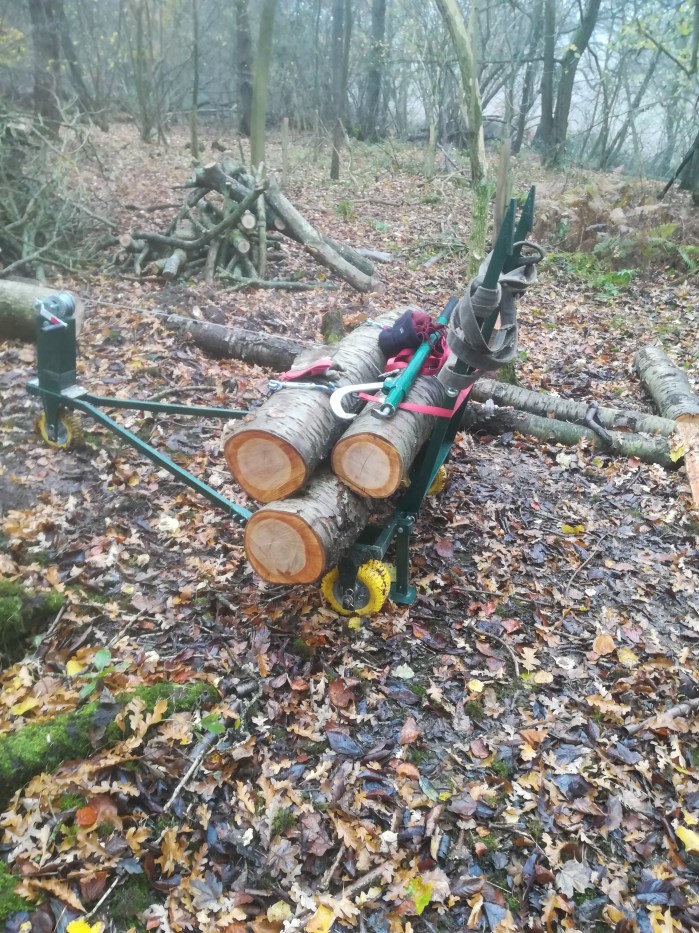
The winch wire is then puled out from the front of the carrier and stretched as far as practicable say 50′ or so and attached to a webbing strap wrapped around a suitably place tree. the winch then is wound in and the carrier pulls itself up the hill. Simples. Having the winch at the front to the carrier means that any snags can be spotted and dealt with without a constant walking to and fro from the winch to the carrier and back etc if the winch was placed at the secure tree end. Whilst not exactly fast progress is steady and the carrier deatl very well with the uneven and spongy terrain very well. The process is repeated a seach tree/anchor is reached. That is the winch wire is released and paid out again, a new anchor tree selected and the webbing attached etc. This way the carrier trundled its way up the wood and reached the more level section at the within an hour or so the worst bit of the steep section had been covered.
However the terrain had taken a toll on the carrier itself.
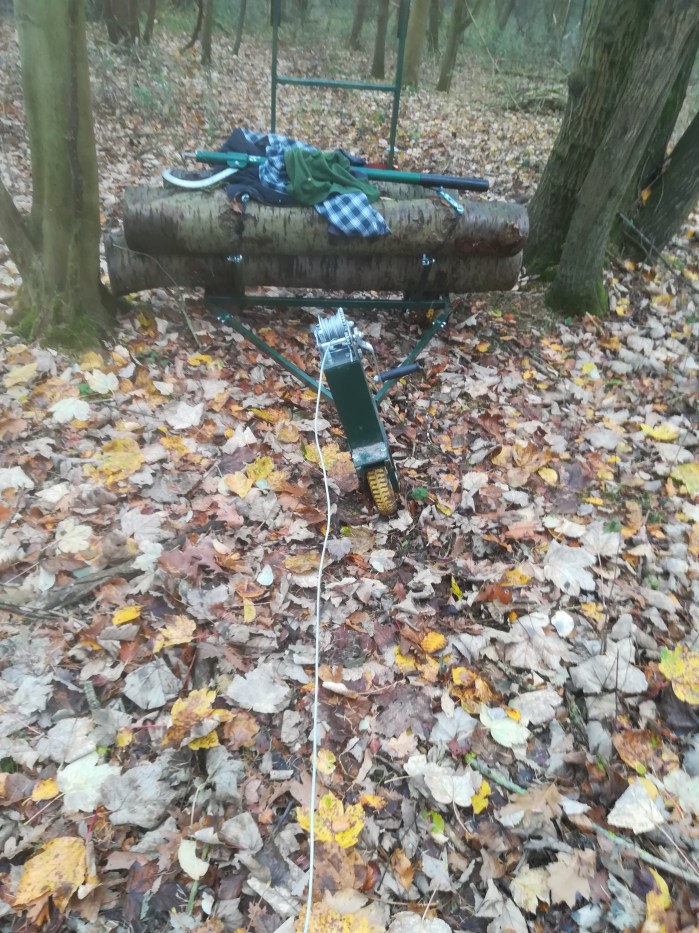
front end going a bit wonky 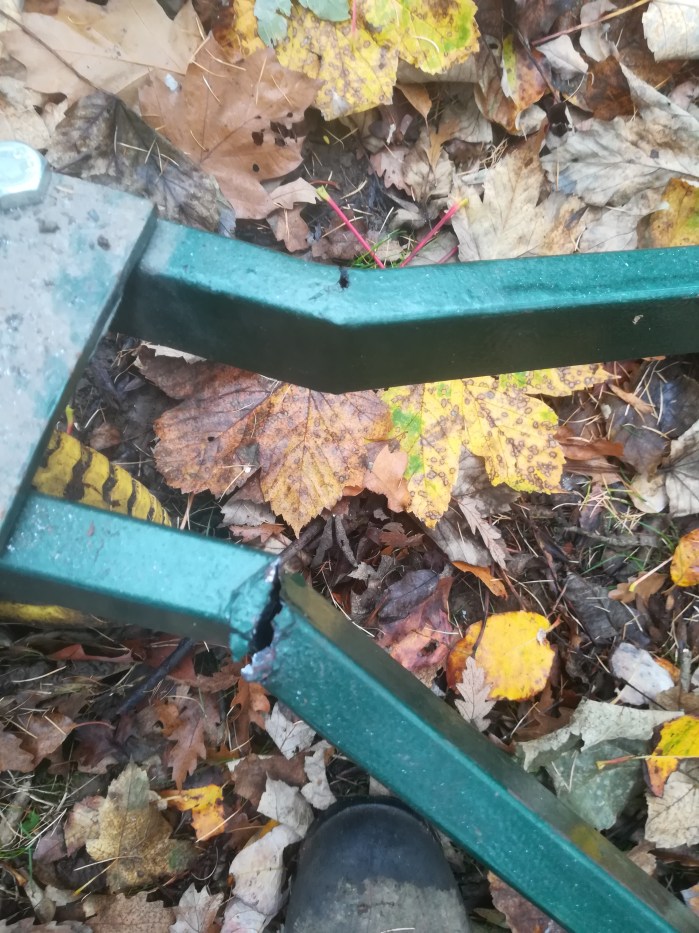
broken weld at fault
The design was great and worked very well but like any prototype it is not until you actually start to use in a real life situation that the weaknesses are revealed. Because of the height of the winch above the base there is a significant turning moment created as the winch takes on the load of the carrier and logs. This tries to turn the front of the carrier anticlockwise and so creates a huge strain on the front welds. Thankfully these only gave out once I had reached the top of the hill and was able to man handle the logs the last few yards.
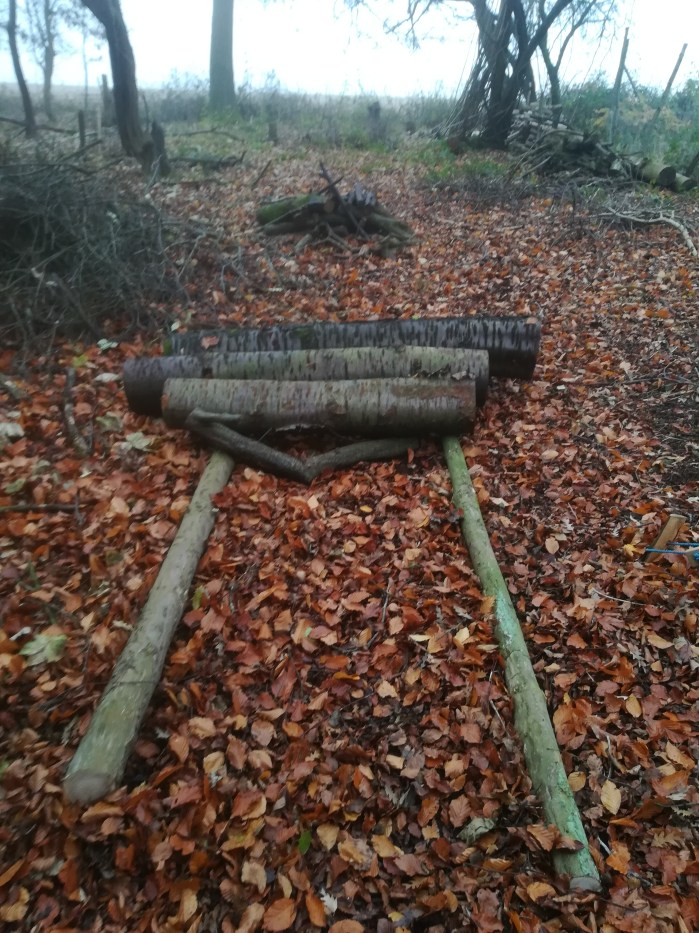
So I was very pleased that the design worked well and am now encouraged to repair the frame, reinforcing the parts that I now know to be weak areas and try again. I am not a welder so my efforts won’t be as a slick as the original but they will be made with chunkier bits of angle iron and bolted together.
I guess it wasn’t all down to the design. In fairness I loaded three fairly heavy logs on the carrier and then pulled it through a very rough route. Still always good to test thing properly so as to learn what to do differently on Mark II.
More next time…………

 Tim Burr