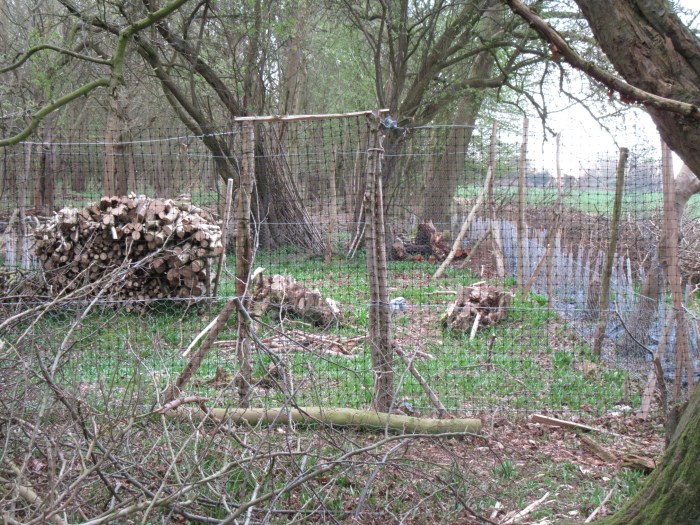
Friday 31st March 2017. It started to rain as I walked up through the wood this morning to inspect the hedge, stark contrast with the weather yesterday when there was bright warm sunshine all day and it reached 20oC. I welcome the short downpour though. There isn’t a water supply in Pop’s wood so all the newly planted trees and hedgerow rely entirely on rainfall, may prove to be a bit of an issue if there is a long dry summer.
First job/distraction was to have a look at the coppiced hazel stools and check for any signs of regrowth. I have been very cautious in my first attempt at hazel coppicing and restricted my efforts to tackling two large stools earlier in November/December last year. These two hazel plants hadn’t been coppiced for over 20 – 30 years at a guess and so had developed into reasonably sized trees with some of their numerous stems/trunks reaching 6″ – 8″ in diameter and an overall height of 20 feet plus. Hazel is a fairly short-lived tree with a life span of say 70 years and if left to its own devices would simply die away at the end of this period. Coppicing (cutting all the growth down to just leave a stump or stool and repeating the exercise every 7 years can prolong the life of the hazel virtually indefinitely as it encourages new roots to form on the stool. After 7 years each coppicing event yields a harvest of poles of various lengths and diameters for sale which can be used as bean poles or as binding rods in hedge laying or example. Wouldn’t it be a bit of a beggar if after 7 years careful tending scientists establish that hazel is the main cause of diarrhoea say and the market drops out of the bottom.
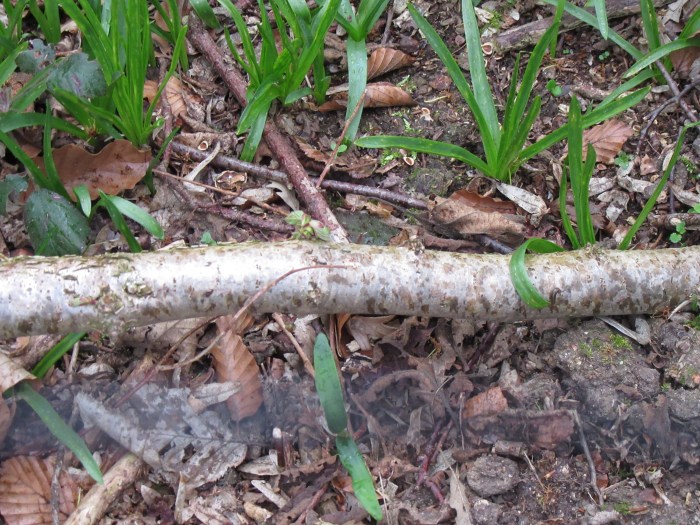
The picture at the top of the page shows the deer fencing placed around the coppiced hazels. This is necessary to stop the deer (and rabbits) simply browsing off all the fresh growth and preventing the stools from a healthy resurgence. Bit of a faff (and expense) to install but seems to have been successful to date. No signs of new growth on the stools themselves but the picture directly above shows a bud on one of the layered branches leading from one of the original stools. These layered branches are designed to take root and encourage a new stool to grow remote from the parent. In fact one of the pieces of hazel that I used to peg down the layered branch has also started to bud! Great news – the process has started.
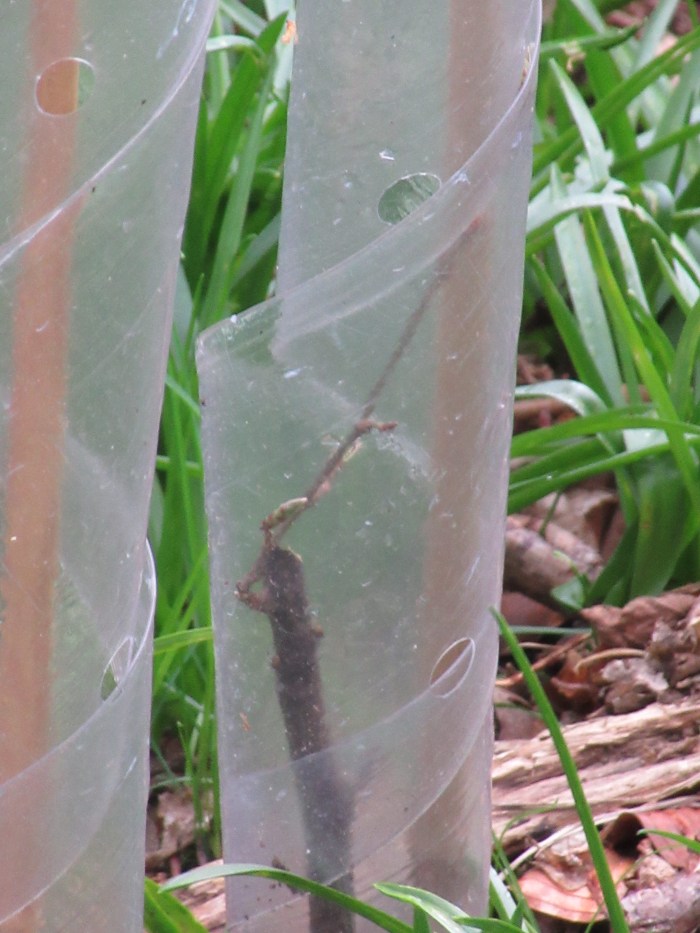
I have also made use of the fenced off area to act as a hardwood cutting nursery and was thrilled today to notice that one of the dozen or so hornbeam cuttings that I planted about 4 weeks ago appears to have taken. Here is a picture of a new bud on the cutting. I am not a gardener and have never tried to take cuttings on anything before let alone a tree so this is very exciting.
I took twelve hornbeam cuttings from trees immediately adjacent to the “nursery” and it would appear that the cuttings of between 1/4″ and 1/2″ diameter have taken root first. Hopefully the others will get established and follow suit very soon. It would appear that size does matter.
More on processing the after math of the huge turkey oak brought down by Storm Doris in the next blog.
 Tim Burr