Time to log off or log on?

Working in the wood in winter sunshine, what a great way to start the New Year . I restarted processing the fallen turkey oak in late November this year after a summer concentrating on learning how to successfully produce charcoal. I had worked through the branches and was left with about 30′ of the main trunk and the knuckle where the tree forked into its main branches. This week, a few days outside of my ambition to finish by the end of the year, I finished chainsawing up the main trunk. Here is a short video showing the last few stages.

Having cut the last remaining section of the main trunk into manageable lumps I will now complete splitting these lumps into logs and stack for seasoning. A lot of the later stages of the trunk were very heavily knotted and are almost impossible to split by hand. For these bits I have reverted to using the chains saw to cut through the gnarly, twisted grain sections. Whilst this is perhaps wasteful purely from a use of chainsaw fuel and production of sawdust perspective;  on balance I think it is far better to go this extra step and produce some very useful firewood from the fallen tree.

Very satisfying to finish this part of the job but rather daunting to think that I have lifted each part of the tree so in effect I have lifted the entire tree. The worrying part is that I will continue to lift and carry the whole tree many times over as I split, stack, load in the van, transport, unload from the van and re-stack at the buyers home! They say that firewood warms you up twice; once when you cut it and again when you burn it – maybe in this case it is not twice but five or six times!

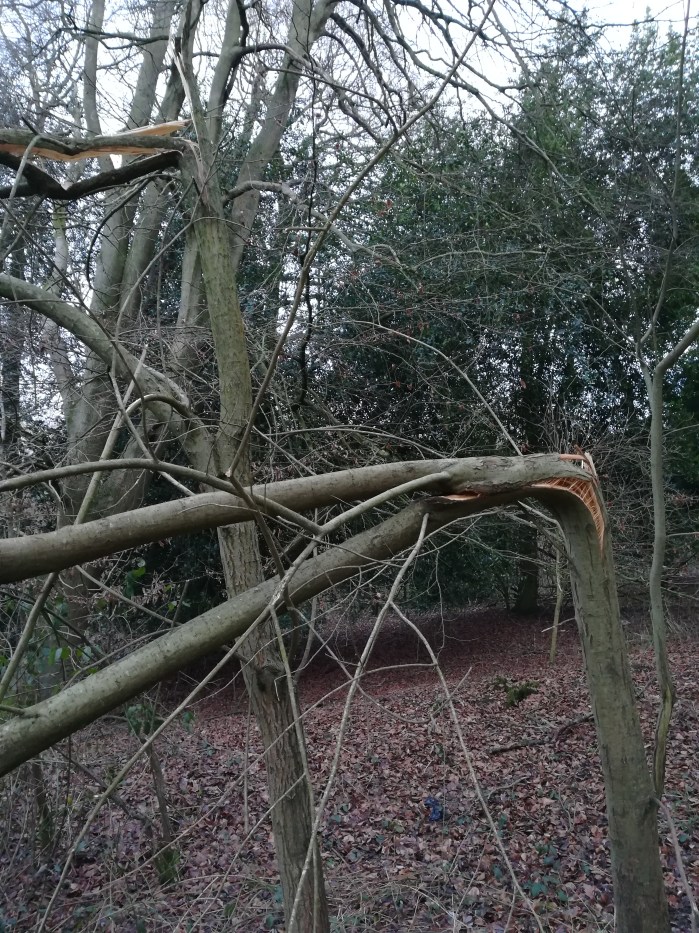
Storm Eleanor blew through the wood earlier in the week, from an initial inspection there was very little obvious damage thankfully. One exception was a pair of small ash trees that I noticed were at an odd angle.
dav

I was confused what had caused the damage as there was nothing obvious at first, the ash trees were too young and therefore too supple to snap under the direct effect of the wind so there must be something else. It took me a while but some way from the trees was a dead branch from a nearby beech tree which must have snapped, fallen onto the trees snapping them before being catapulted off again to lie some distance from the snapped trees. Seems a shame that a dead part of a well established tree can take out a younger tree – net gain zero.

More next time……………………..
 

A wood laid bare and a deer bare patch

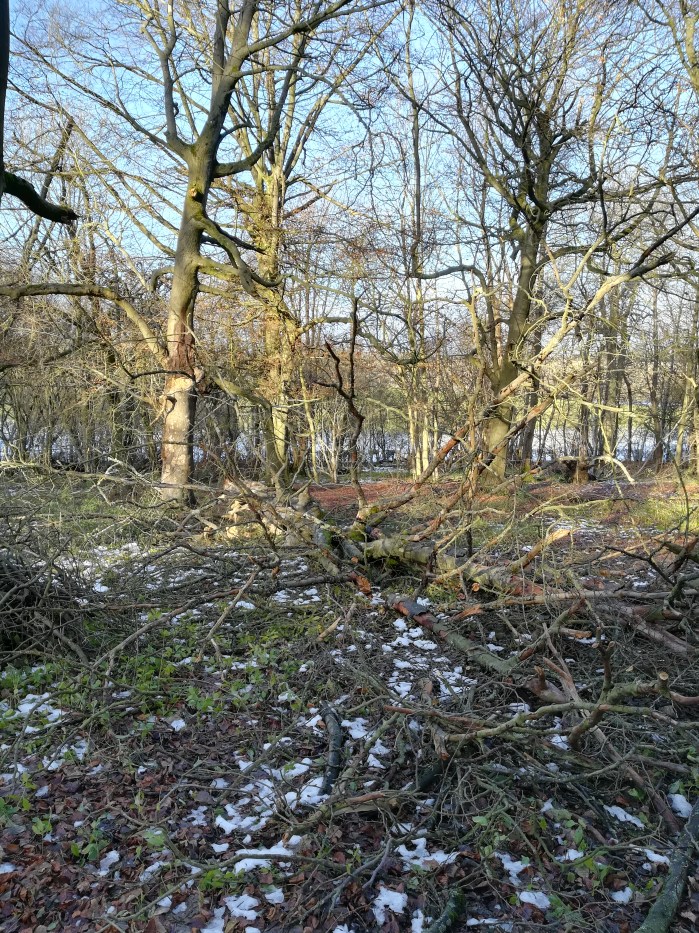
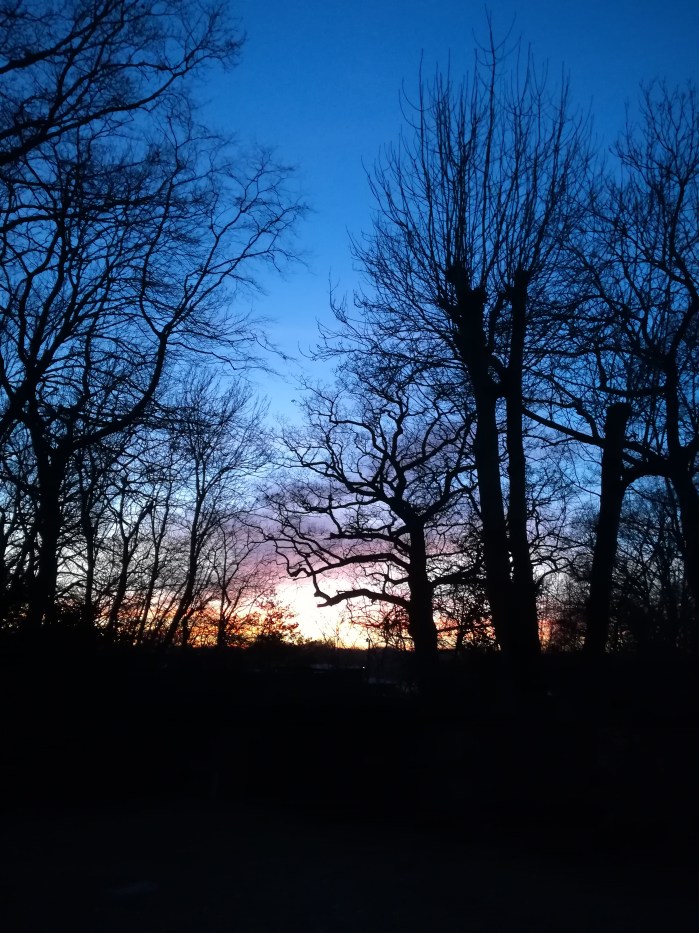
The difference in the feel of the wood between the seasons is very pronounced. At the moment the trees are absolutely bare and there is a very open feel to the woodland.  There are clear sight lines through the wood from top to bottom and along its length that simply don’t exist at any other time of year. Because the sun is very low in the sky the lower parts of the wood don’t see direct sunlight at this time of the year and the field opposite which is half in shade has a distinct frost/no frost shadow line throughout the day. But what sunlight there is now manages to get through the bare tree skeletons and finds the woodland floor, for the area beneath the beech branches this is the first time since the summer.

The snow has all cleared away and the temperature in the wood this week was a heady 12°C which made for idea working conditions. Still more of the same with the remaining fallen oak tree log. This current section of the log has a number of substantial  branches sprouting and these are as tough as old boots to split. Having broken them off the main trunk some of the sections have gone on the “difficult to split” pile which will be tackled at a later date.


I think that I will have to revise my target and aim to have the remaining 8′ or so of log finished off by the New Year!

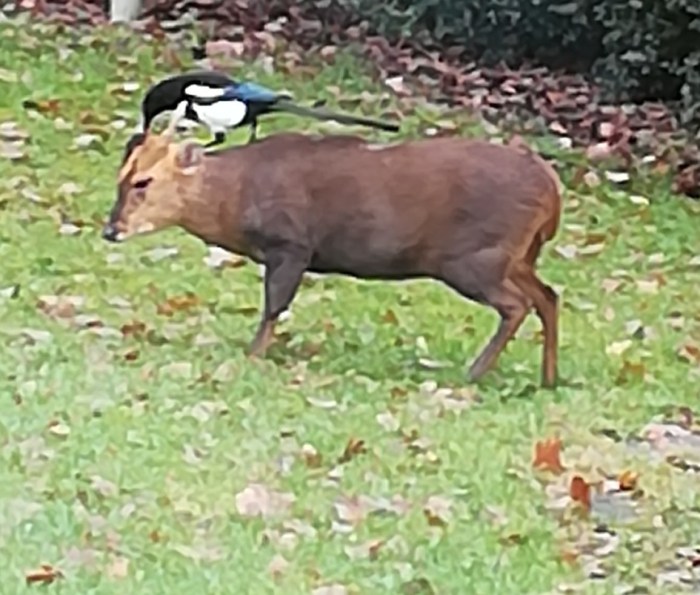
Curious what happens when you look out of the window. Sat at home I noticed a muntjac deer browsing on the lower branches of a yew tree and then some fallen leaves on the lawn. So far so normal. These animals are regular visitors to the garden and though not entirely welcome, as they eat anything and everything, they are attractive creatures and part of the local fauna. However, what happened next was unexpected. A large magpie flew down from a branch and landed directly on the muntjac’s back and proceeded to peck vigorously at the fur. The muntjac appeared to be accepting of this and stood absolutely still making no attempt to shrug the bird off or flee. However it didn’t look like a symbiotic relationship ie where the magpie clears off unwanted lice for the deer – the action appeared to be far too aggressive and there was what appeared to be a bald patch on the deer’s lower back after the event. Not sure whether this was a one off event with these two particular creatures or one that takes place on a more widespread basis. Very odd to witness.

img_20171222_134100_1.jpg

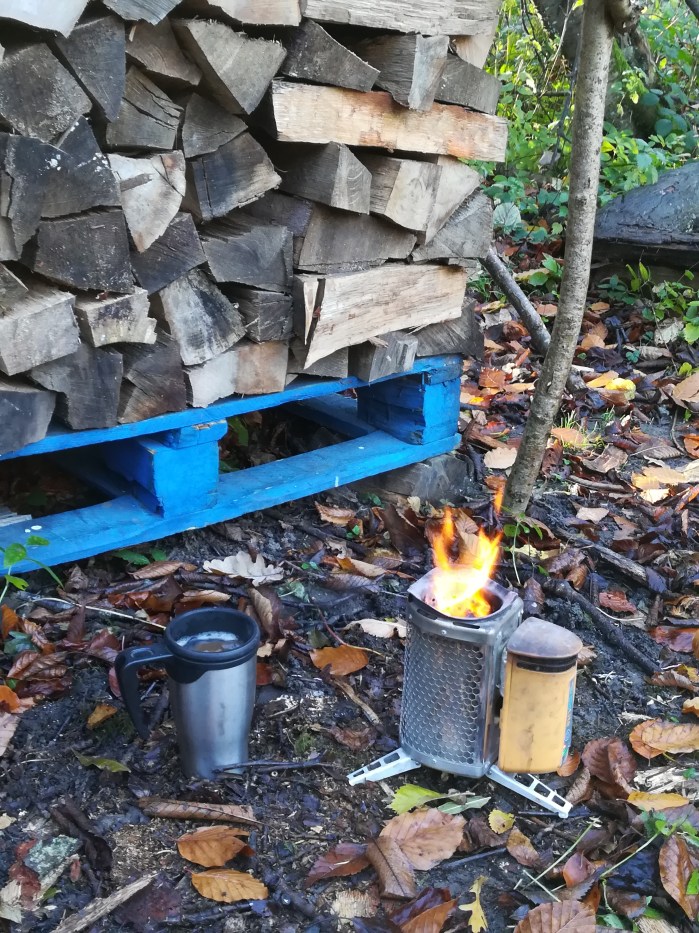
Ah well time for a brew….


More next time……..

A cold snap…another branch down

Last Sunday the snow started to fall and kept falling for most of the morning with a thick covering by lunchtime. It was the sort of snow that stuck to everything, including the branches of the now bare trees. As often happens when it is actually snowing, the temperature was not that low and in fact the snow as very slushy and beginning to thaw later in the afternoon. It felt as if the snow would  go as quickly as it came and we would be clear again. But overnight on Monday there was a deep frost with the temperature at -4oC, giving the thawing snow a crisp feel and welding it to all that it touched.

As I drove to the wood there were many examples of branches that had snapped under the extra loading of the ice and now littered the roadside. Fir trees seemed to be particularly susceptible. I guess that is the consequence of having branches with needles year round. They had caught the original snow fall and looked beautiful but then as the snow partially thawed and the refroze the weight on the branches became too much and they snapped off. It is amazing to think that something that looks so fluffy and innocent as it falls as individual flakes can become a real threat to well established and healthy trees.

Christmas Log

The main picture at the top of the blog shows some damage much closer to home in Pop’s Wood. Sadly over the years a number of mature beech trees in the wood have died and I am advised that this is a result of changing ground conditions. Beech trees love to be on well drained chalky soils and so when the ground becomes a bit heavier or holds the water they become stressed and eventually die. The latest to succumb to just such a process. For reasons I don’t understand yet the ground around the tree has become water logged and the tree, that is in excess of a hundred years old, has simply “drowned”.  When I discussed it with the the wildlife trust people they said that the best thing was to leave it as standing dead wood as this would encourage insects and in turn support various birds.

I guess part of that process is that the tree continues to decay and weaken and this week a main part of the trunk broke away and fell to the ground. Whether this was as a result of the severe frost I don’t know. Leaving the tree as standing dead wood is fine as far as supporting wildlife but raises the question as to how safe being underneath the tree is as it continues to decay. I may well revisit the decision to leave the whole tree standing and see if it would be more sensible to trim off the main branches and simply leave the trunk.  In the meantime I will process the fallen wood and store for potential firewood and making into charcoal.

More next time…….

Wild Cherry – ma chérie!

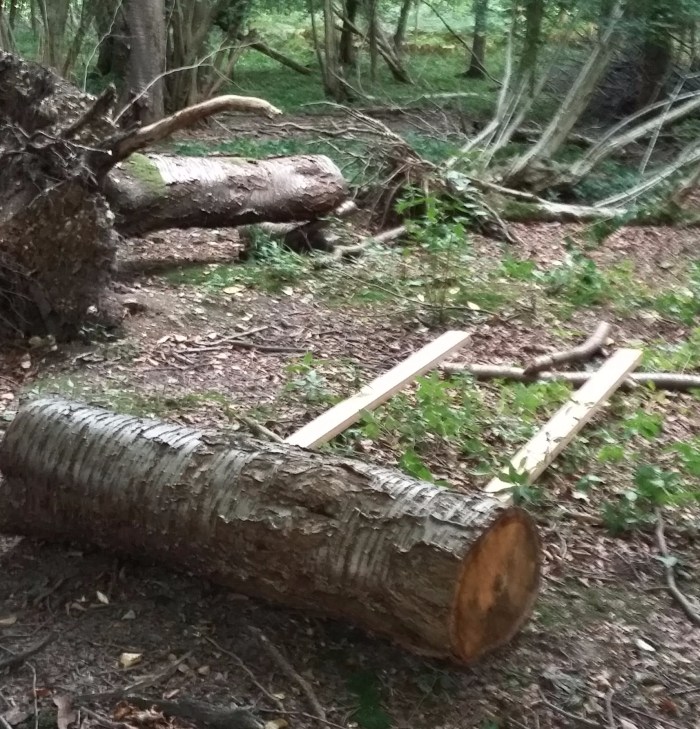
Wild cherry trees seem to have a definite life span and once they reach a certain size or age they appear to simply keel over. In February 2016 my brother and I spent a day in Pop’s Wood hand sawing a log from just such a wild cherry tree that had collapsed onto the top of a hazel stump.

It was hard going with the two man hand saw but we managed to get through it cleanly and revealed a lovely heart shaped profile to the log – very fitting for February.

Moving the log relied on the ancient technology of wooden rollers, levers and sheer muscle to get it into the back of the car to transport it home.

Next job to was get it onto the saw mill and the very satisfying job of sawing it up into planks, stacking the planks with stickers in place between the layers to allow the timber to dry out evenly.

That was back in August last year and the planking has been drying out now for over 12 months. This week I started with the next stage which is to saw the rough waney edged planks into usable lengths of timber and then plane them to a smooth finish on all faces.

Great to see a felled tree through all the various stages.

It is sobering to consider the amount of forward planning that is required and the time lag/investment necessary to allow each stage to take place properly. For example you can’t hurry the seasoning process without a great deal of additional energy input. You also have to carefully control a micro environment around the drying timber to prevent end splitting of the planks which effectively ruins the finished product. Or…..you just have to wait for nature and time to season the wood.

Once my felling licence is in place the intention is to fell a number of wild cherry trees and stock pile a reasonable amount of planked wood so allowing a reliable supply to sell.

More next time…………..


Hammer and wedge – side splitting work.

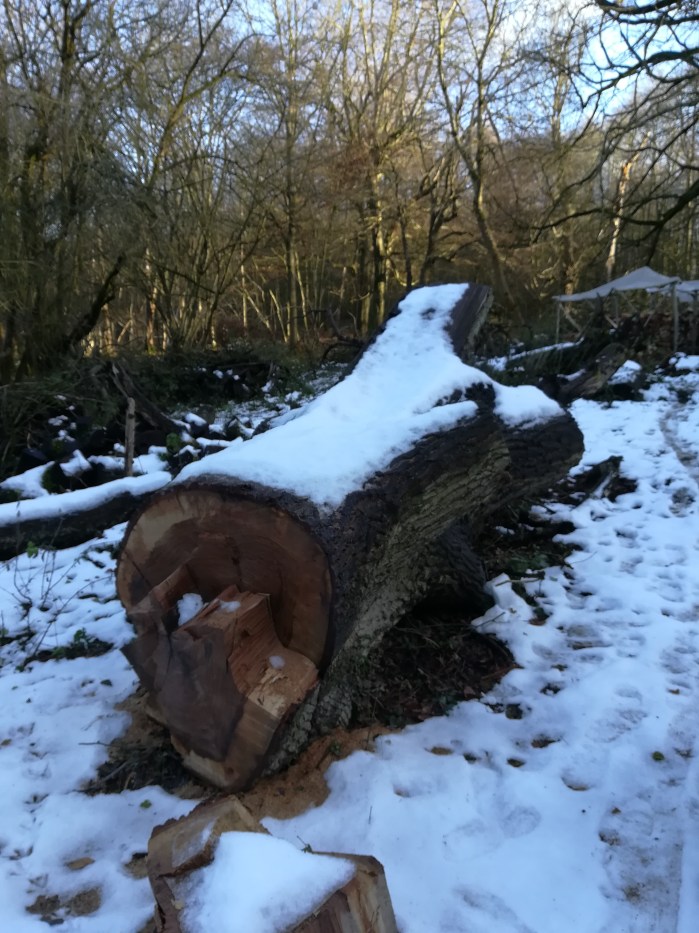
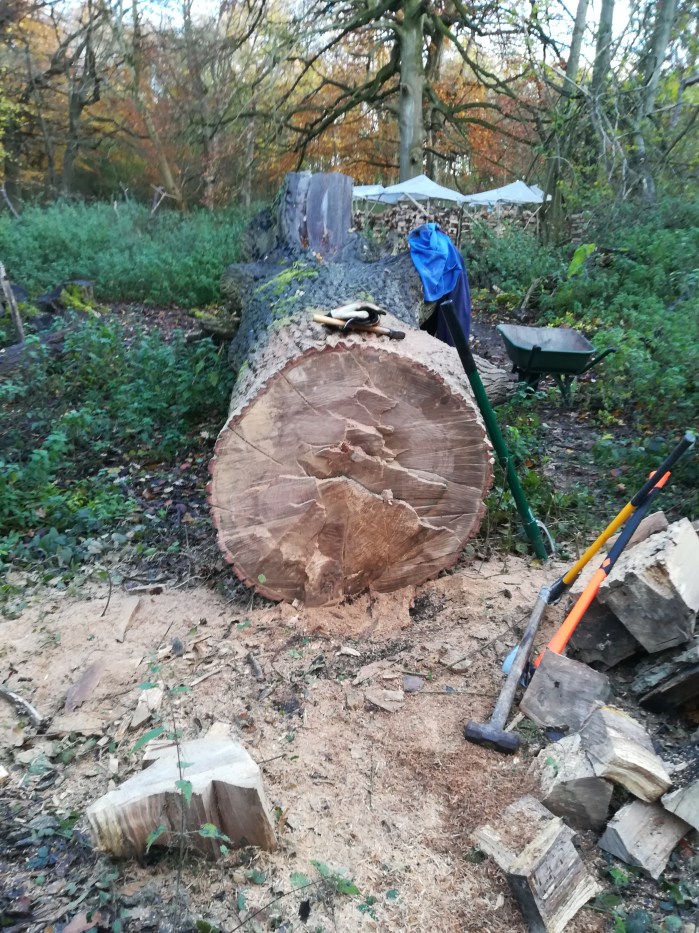
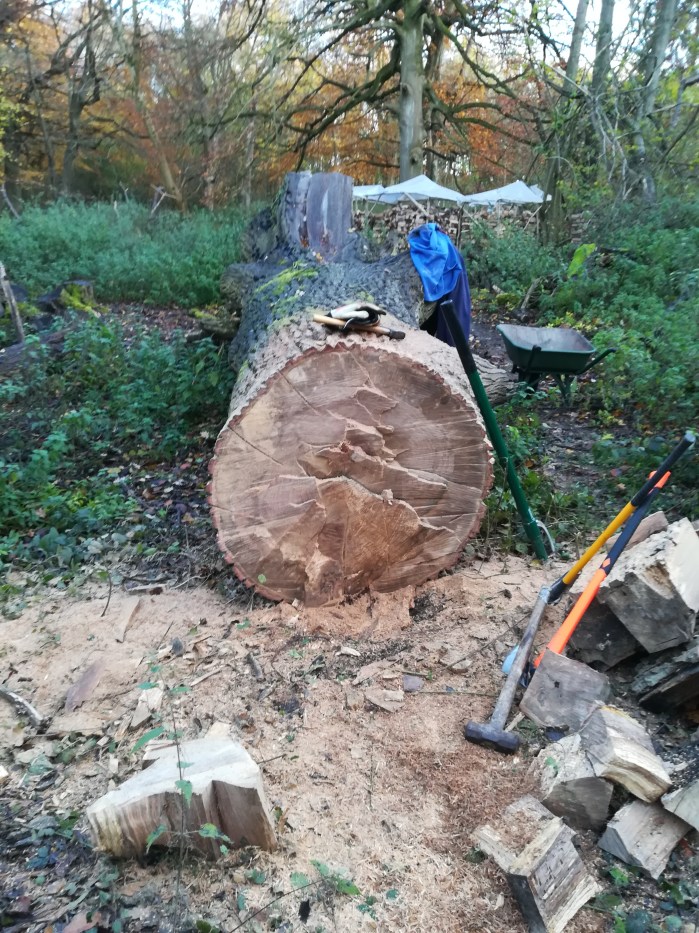
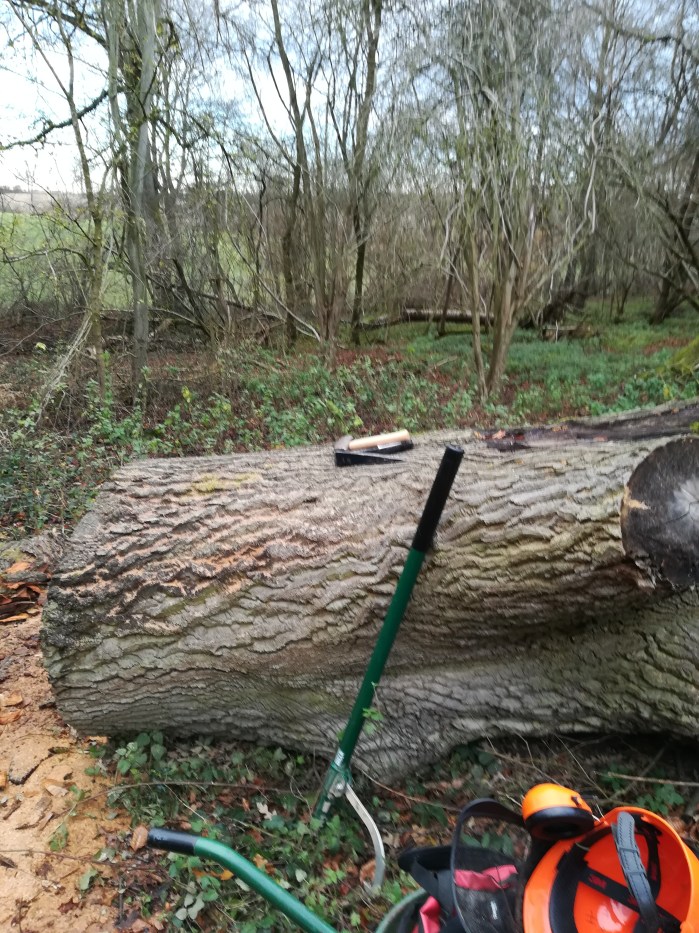
The target is to have the rest of the fallen turkey oak main stem all sawn up into sections and processed into logs by Christmas. This is quite a challenge as there is about 12 ft of stem left and the diameter of that “log” is over 3 ft. This means that the chainsaw bar, which is only 18″ long, will not make a clean cut all the way through and so numerous separate cuts have to be made. This is why the end of the log show in the main picture looks so uneven as if it has been chewed off.

dav

In addition there are several stumps of sizeable branches that were part of the main tree when it was standing. Where each of these branch stumps joins (or sets off from) the main stem there is a complicated interplay between the straight grain of the stem and the straight grain of the branch producing a very tough piece of wood that is hard to split.

Still I have developed a technique now that seems to be effective. It goes as follows:

  • Mark out a hoop to cut off that is about 10″ in depth. Start at the 12 o’clock position and cut as deeply as the bar will allow down one side, being careful not to touch the ground at any time as this will instantly blunt the chain saw;
  • Repeat for the other side.
  • Stand at the front of the log and cut notches with the chainsaw as if marking out the hour positions on a clock face;
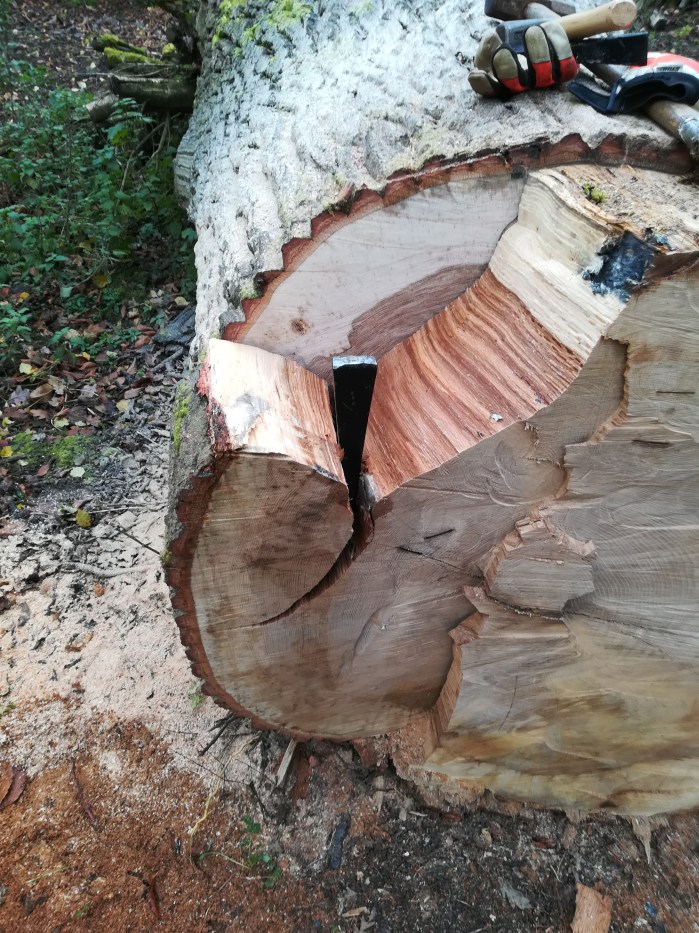
  • Insert a splitting wedge into the first notch and hit it hard with a sledge hammer until a split starts to form in the end grain of the log (It is unlikely that this first split will result in a section being split completely off)
  • Leave the first wedge where it is and insert a second wedge into an adjacent notch and again hit it hard with the sledge hammer. The likelihood is that this second split will join up with the first split and produce a satisfying crack as a section of log, rather like a badly cut piece of pie, comes free and can be removed.

dav

  • As the bulk of the log gets removed there is then room to get back in with the chainsaw and setting the blade at a slight angle it is possible to nibble away at the remaining uncut wood and continue using the wedges to split the pieces away from the trunk
  • The cant hook (shown below) is a great way of leveraging the sections that are not quite broken through. This tool is about 4′ long and with the spiked jaws firmly gripping the broken log it is very effective.

  • Once the whole of that hoop is cut off the main stump, the bark is stripped off each of these split sections with a hand axe and the logs split into firewood size blocks. The removal of the bark helps the air get to the logs allowing the trapped moisture to dry out, also improves the appearance of the cut logs no end.

20171013_101102

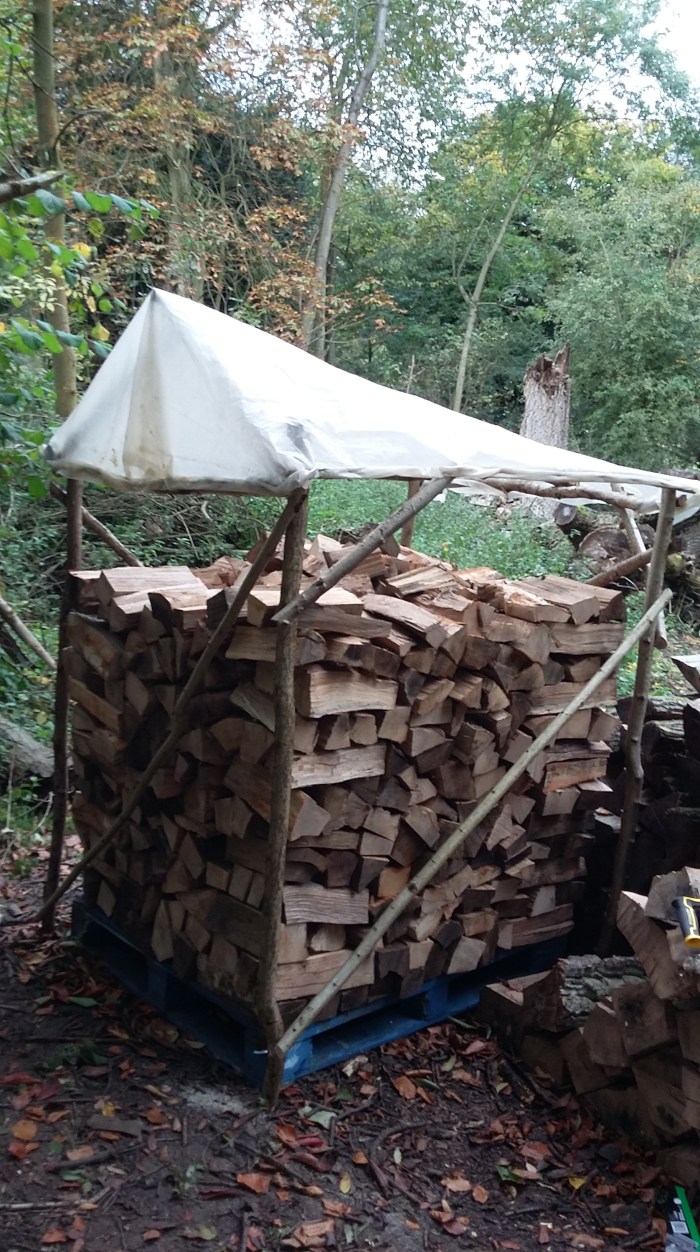
And before you know it you have a cubic metre of firewood starting the seasoning process. The simple shelter made of hazel poles and plastic sheeting protects the logs from rain and allows them to slowly dry out.

More next time…………………..
Lousy job but they seem to enjoy it….particularly the ammonia farts!

Everywhere you look in a woodland floor setting there are woodlice. As I am chopping logs they drop out of various nooks and crannies from within the log. They seem to be able to survive in the smallest of unpromising places and, having been disturbed by a large axe splitting their home apart, they simply uncurl and scurry off to find a new place. Given that they are largely nocturnal they are probably blinking as they run off wondering what the bright light is all about.

Porcellio scaber and Oniscus asellus - Zalné20070205.jpg

Here are some facts that I found in a study sheet produced by Waltham Forest:

  • Woodlice may look like insects, but in fact they’re crustaceans and are
    related to crabs and lobsters.
  • It’s thought there are about 3,500 species of woodlice in the world, and 35-40 of these can be found in the British Isles.
  • Woodlice are sometime called pill bugs and slaters (in Scotland). The pill woodlouse gets its name because it can roll itself up into a ball.
  • Woodlice like damp, dark places and can be found hiding in walls, under stones and in compost heaps.
  • A woodlice has 14 legs and an outer shell called an exoskeleton. When a woodlouse grows too big for its exoskeleton it has to moult to allow a new shell to take its place. Moulting takes place in two stages, first the back half is shed and a day or so later the front half falls off.
  • They have a pair of antennae to help them find their way around, and two small ‘tubes’, called uropods, sticking out the back of their bodies.
  • The uropods help them navigate and some species use them to produce chemicals to discourage predators.
  • Most woodlice are found on land, but their ancestors used to live in water and woodlice still breathe using gills.
  • Woodlice eat rotting plants, fungi and their own faeces, but they don’t pee! They get rid of their waste by producing strong-smelling chemical called ammonia, which passes out through their shells as a gas.
  • After mating, females carry their fertilised eggs in a small brood pouch under their bodies. The young hatch inside the pouch and stay there until they are big enough to survive on their own.
  • A common woodlouse can live for three-four years.
  • Apart from man, its main predators are centipedes,
    toads, shrews and spiders.

Given that the pile of oak logs is not rotting and would be too dry for their liking I guess that they are simply using the shelter afforded by the cracks and splits in the logs as a refuge during the day and then set off foraging from there each night.

Seems like the woodlouse is on the whole a beneficial partner. It feeds on decaying leaf and plant matter on the woodland floor, meaning that the woodlouse prevents the organic waste rotting and giving off carbon dioxide and so plays a vital role in the natural carbon dioxide cycle. I wonder whether there is a further advantage in their ability to produce ammonia albeit in a gaseous form that could have a beneficial fertilizer effect.

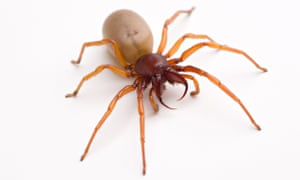
But its not all eating rotten wood and farting ammonia. Who likes to eat woodlouse? Well the woodlouse spider for one – how depressing would it be to have a predator with your name in their title! At just over an inch log these are about the same size as a fully grown woodlouse but their mandibles at the head end make it a very efficient woodland predator. They hunt for woodlice underneath logs and stones within the woodland setting. Their powerful jaws are deadly: piercing the louse’s tough armoured exoskeleton with ease. Apparently they can give humans a nasty nip so watch out.

Woodlouse spider

Amazing to think of the incredible amount of life that exists literally right under our feet. Classic food chains playing out with the hunters becoming the hunted at the next turn. Each tiny seemingly insignificant entity fulfilling a purpose and going about its business relentlessly. Scary to think of how easily we break those cycles and wonder years later what went wrong with our ecology. We really must learnt to tread more lightly.

Says he who uses a chain saw to cut down a million habitats!

More next time………….

The rot stops here!

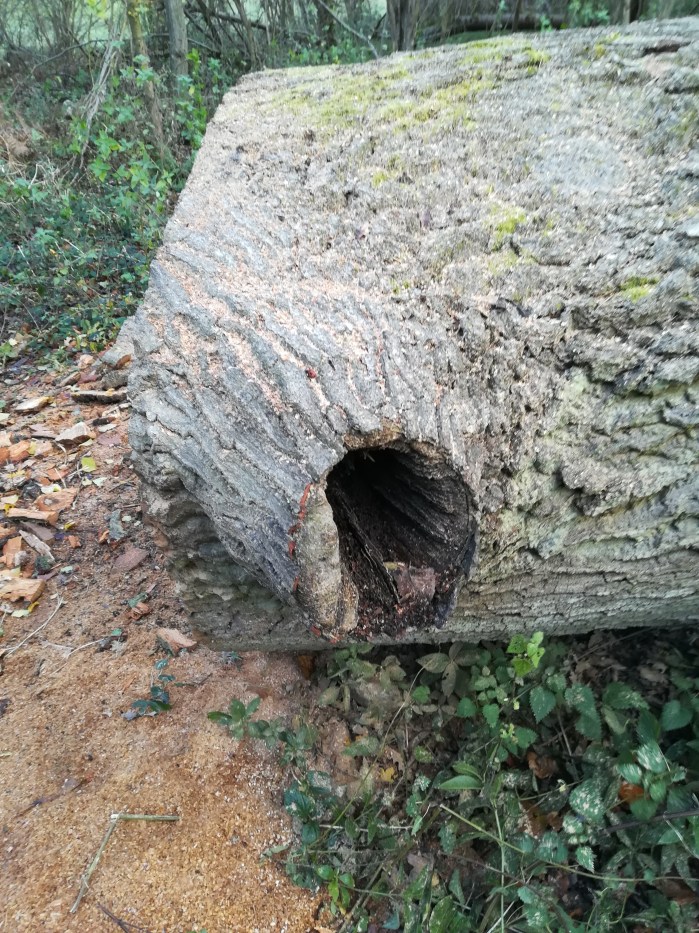
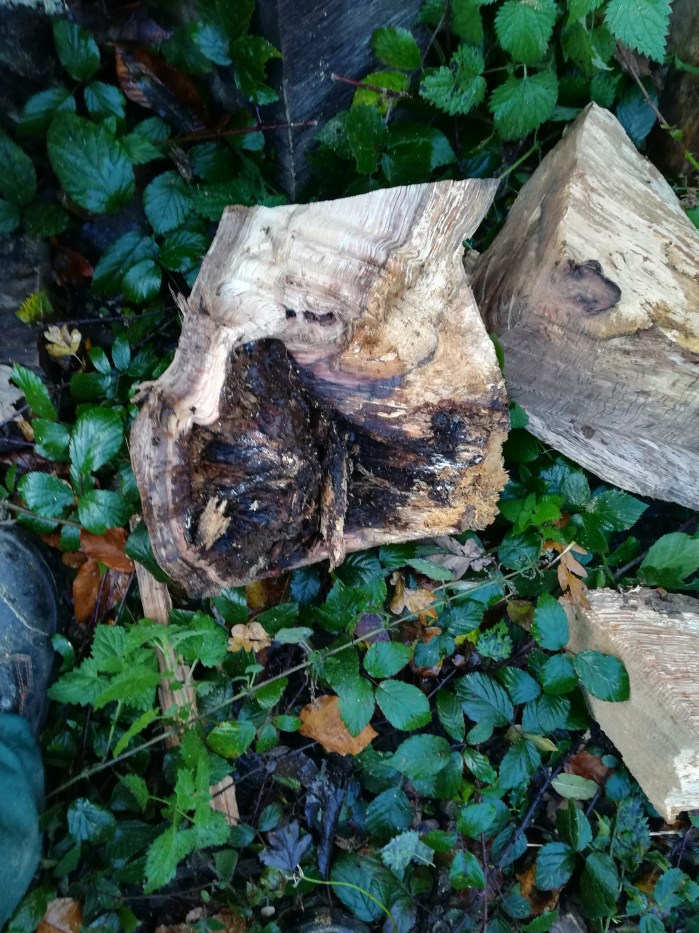
Back in May I was in the middle of tackling the huge stem of the fallen turkey oak that was blown over by Storm Doris. In an earlier blog I noted that there was a section of the trunk that was rotten in addition to the fungal roots (myceleum) that ran in a seam up the tree. After spending the last month processing the pile of logs that I had created in the summer I was now ready to get onto clearing up the last section of the trunk. Yesterday afternoon I chainsawed off a further 10″ hoop and was very pleased to note that the rotten section disappeared from the uncut portion. Further exploration showed up a ball like cavity in a part of the log that I had cut off. It looked as if it was where a branch had previously sprouted but had broken off at some stage leaving an opening for water and the decay process to start. Picture below captures the ball like cavity.

sdr

The wood from here on upwards should be free from rot which is a great news from a creating firewood perspective.  One downside is that the natural weakness created by the rotten bit was where I found it easy to start of a running split to ease off the logs out of the cut hoop. Now that is no longer there I think I will invest in a couple splitting wedges to enable me to create splits and so more easily break the cut sections off the main trunk.

Lovey frosty start to the morning yesterday which was very beautiful but usually meant I had to scrape the ice off the van windscreen and because there must be some moisture in the cab also had to scrape it off from the inside. The day developed into a classic sunny autumn day, a great time to be outside working and getting warm as you go. Time for a mid morning brew which I don’t usually bother with but for some reason fancied doing yesterday.

dav


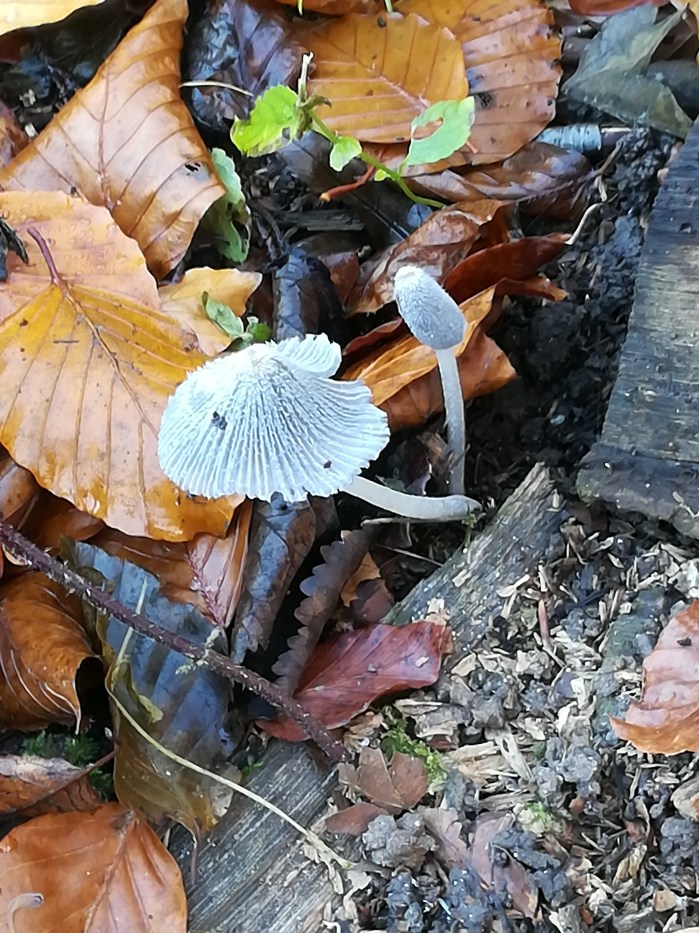
Stumbled on a mushroom shown below as I cleared the last of the logs away.

dig
frosty looking mushroom

I have had a look in the “All you wanted to know about fungi but never dare ask” book at home and unfortunately it looks like three possible options. The one that I would like it to be is one called Wood Woolly Foot but I am not sure it qualifies as it doesn’t appear to have woolly feet. I have sent off the picture to the UK wild food people and asked for an identification.

More next time……

PS I got a very prompt response to my mushroom enquiry and they have narrowed it down to be a Coprinellus Nivea or Lagopus. These have common names of Snowy Ink Cap and Hare’s Foot Ink Cap respectively. I will see how they mature but apparently the species is deliquescent which means that the solid matter becomes liquid as it absorbs moisture from the air and ends up as a pool black ink. I will keep an eye on it over the next week.


Sycamore or perhaps syc-amour

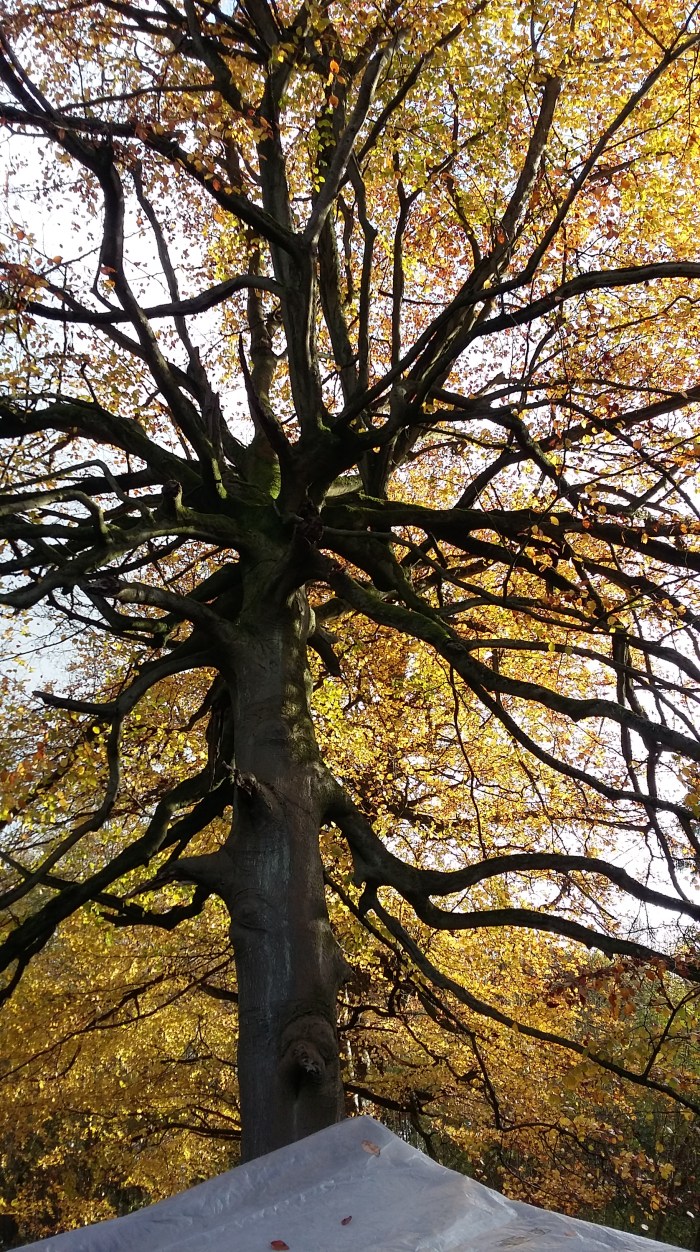
The tree canopy at Pop’s Wood is rapidly losing its thick covering of leaves as Autumn progresses. The beech tree which is a bit slow to start in the spring develops a very thick canopy of leaves over the late spring and summer to the extent that it shades out virtually everything else underneath. It is not until this time of year when the beech leaves start to fall that the light once again penetrates through to the ground. Yesterday was a picture, the beech was back lit by the soft afternoon sunshine which accentuated the golden yellow of the faded leaves still left on the branches and threw into sharp relief the huge structure of the tree itself. What a lovely sight.

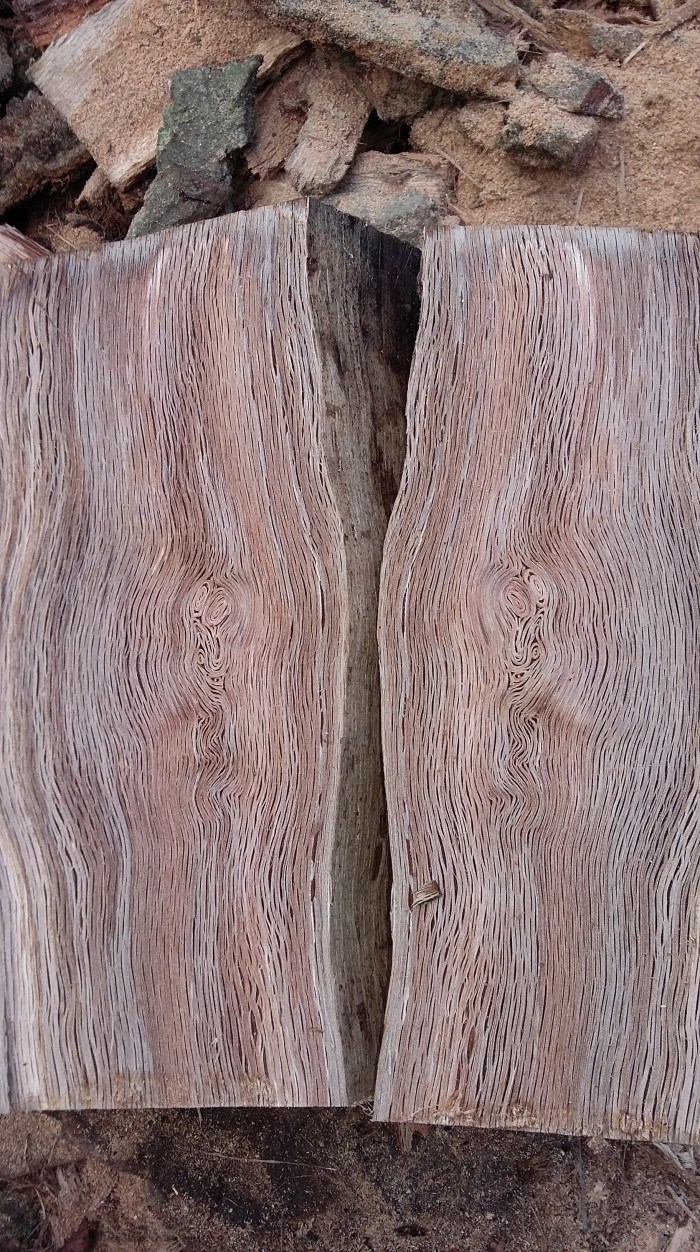
Chopping wood is not always the most interesting activity but it has the advantage giving you a good workout with plenty of time to think whilst also concentrating on not chopping any of your limbs off. Another advantage is that there are occasional aspects that catch your eye and make you marvel at the beauty of the wood that you are handling.

20171108_141605

The complexity of the grain patterns in the picture above are amazing. Why did the tree develop this particular loopy series of scrolls? Was it the point where a branch started out from the main trunk? What we can be certain of is that the growth would have been a pragmatic response to an event of some form and would not have been for artistic reasons. The visual effect though is artistic and  stunning. It always makes me think at this stage that I am the first human being to have ever seen this part of the tree, this is the first time that it has been exposed to the outside world……and now you can see it as well.

Part of my management plan for Pop’s Wood was to take down some sycamore trees and replant a stand of ash trees that I would then coppice on a 10 – 12 year cycle. So every 12 years or so each of the trees would be cut back to just above the ground and the stump left to regrow over the next cycle. When we walked around this part of the wood the adviser from the Wildlife Trust suggested that a better approach may be to pollard the existing sycamore and fence of the immediate area around the existing sycamore trees to allow natural regeneration of further sycamore saplings from the fallen seeds being allowed to survive and not be eaten by deer. This suggestion could be a good idea for a number of reasons:

  • The ground conditions are obviously suitable for growing sycamore as the trees are healthy;
  • Ash is going to struggle to survive the die back disease and sycamore is seen by some as its natural successor as it appears to be less prone to disease;
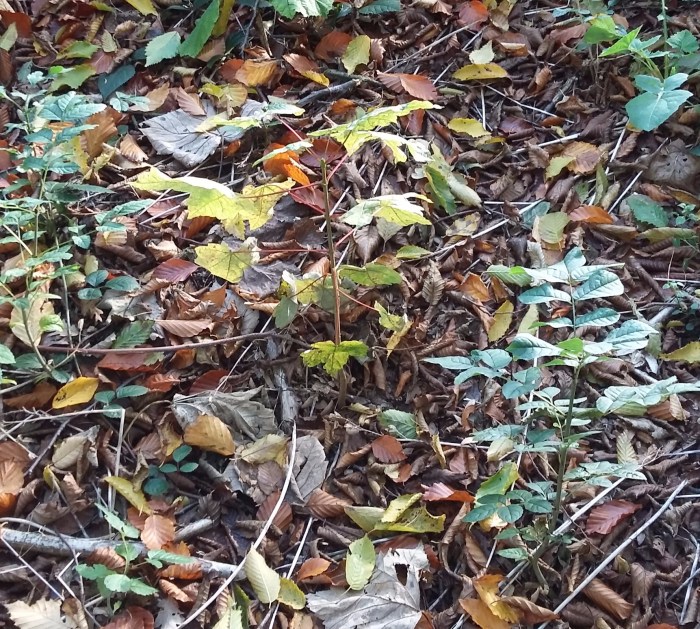
  • natural regeneration is already happening in the fenced off hazel compound that I erected last autumn, there are about a dozen healthy sycamore saplings (see picture below) that have thrived since they have been protected from deer grazing ; and,
  • Pollarding, which is pruning a tree back to the stump but above deer grazing height, minimises the damage that deer can do to the regrowth and so makes the enterprise a lot cheaper and virtually maintenance free.
20171110_131819
Sycamore – and ash saplings thriving in fenced off compound

There are other considerations which need to be carefully thought through:

  • Will the fresh growth on top of the stumps be susceptible to wind damage and tear away;
  • how is it best to cut a reasonably mature tree back for the first time because it involves working at height with either power or hand tools; and,
  • will the resulting growth be suitable for anything other than firewood?

The Forestry Commission are generally supportive of the approach and the world seems to becoming a little less unfriendly towards the sycamore. It was introduced in Medieval times and seems to have been treated as a new comer ever since. Given that it may well come to the rescue in terms of filling the gap formed by ash dieback perhaps it is time to embrace the sycamore and let it feel loved……sycamour.

Walking the wood……lots to learn!

As part of my application for a Countryside Stewardship Grant I have produced a draft woodland management plan. This sounds very grand but is simply a way of thinking through and formally capturing a fairly detailed set of objectives for the wood over say the next 10 – 20 years. To assist with this there is a very good software package available on the Forestry Commission web site. This leads you step by step through each of the stages that are necessary to organise your thoughts into a coherent document.  What the process reveals is that you have to be very thoughtful about what you seek to achieve in the wood and think through the consequences of the steps that will be necessary. Anything to do with woodlands takes place over time spans of many years and so a commitment to take down a mature tree needs very serious consideration. The sobering thought is that whatever you plan to achieve it is unlikely that you will see the mature results in your lifetime so you are really planning for the next generation.

Having said all that there are shorter timescale activities that can become a part of the plan such as coppicing hazel and pollarding ash, sycamore or even hornbeam. These have shorter cycles of say less than 10 years from start to harvest. But I was chatting to someone who has been in charge of coppicing at an estate and is only now after the third cycle thinking that the coppice is beginning to mature into a productive site. So that’s three lots of seven years – 21 years for a hazel coppice to reach its maturity and re-enter the productive phase.

As part of the management plan an expert in the flora and fauna for the area visited the woodland this week and spent an hour and a half walking the wood and commenting on what I had planned and making some very helpful suggestions. It is always refreshing to have an expert offer advice before you leap into action. as mentioned earlier some of the decisions have real consequences which cannot be easily undone .

Purple Emperor (male/upperwing)

In one part of the wood there are several clumps of rather scruffy looking tress which I had previously struggled to identify but had eventually determined were goat willow. These I decided were of little use in a woodland intended for growing timber and wood products. However during the visit they were described as being very impressive examples of mature goat willow and an important habitat and food source for the increasingly rare Purple Emperor pictured above. We agreed that a sensible change to the management plan would be to leave a small copse of these trees standing to maintain the opportunity for these beautiful insects to breed and hopefully recover their numbers.This is a priceless piece of information that has enhanced the management plan and ensured that my artificial interventions have as light a footprint as possible.

It was impressive to listen as the visitor deduced the history of the wood simply from the vegetation covering the woodland floor.  The plant pictured below is growing across a large part of Pop’s Wood but not everywhere.

Dog's mercury - Philip Precey - Philip Precey

This is Dog’s Mercury and the Wildlife Trust site has the following description….”Dog’s Mercury has spear-shaped, toothed, fresh green leaves carried on upright stems. It produces a foul and rotten smell and bears clusters of small, greenish flowers in spring.”

It is also a very reliable indicator of ancient woodland sites and explains why the expert was able to say that parts of the woodland were a lot younger than the rest due to its absence across the whole wood. Bluebells fall into a similar category and also indicate ancient woodland activity.

Ancient woodlands are woodlands that have existed since 1600AD in England and Wales and 1750AD in Scotland. Artificial planting was uncommon before these points in time.
Ancient woods are our richest land-based habitat for wildlife. They are home to more threatened species than any other, and some may even be remnants of the original wildwood that covered the UK after the last Ice Age 10,000 years ago. Yet today, ancient woodland covers only around 2% of the UK’s land area.

Quite a responsibility when I think through my management plan and how best to develop its future for the next generations and beyond. Best keep that chain saw unused and reflect for a little bit more before starting. More next time…….


Watching wood dry and making a new handle.

How does wood dry when the relative humidity in the wood is 75% at the lowest? Confusing to think that the stack of firewood that I have chopped will air dry in the open air to about 14% to 20% moisture content yet be sat in an atmosphere that has a relative humidity of 75% at the lowest. Yet the drying process has already started with the moisture meter showing that the logs have dropped from in excess of 40% moisture level to around 30%. At 100% humidity chopped wood will never dry. Temperature does affect drying speed, but even at -20C it will get dry eventually.

Drying times will decrease as air humidity decreases, and as air temperature increases. However, the process is not entirely reliant on temperature and in fact the speed of the drying process seems to depend on a number of factors. If the air is warm and dry, but there’s no wind, clothes dry slower than if it’s colder but there is a wind. The wind is therefore important. Air circulating past the wood allows water from the atmosphere to drop out onto the wood but also drives the evaporation process which takes water from the wood and transfers it to the passing air. Although the average relative humidity seems high at around 70 – 80%, as long as it is below 100% there is room for more water to be transferred to it and so objects will dry. The lower the humidity number and the higher the temperature then the quicker the process will be as long as there is a wind to create a movement of air past the stack of wood to allow fresher air to take part in the process. To exaggerate this point if I were to stack a pile of logs in an airtight box with a glass lid and leave it out in bright sunlight then I would have a very high temperature but because there is nowhere for the water to go once the trapped air reaches a 100% then the wood would not dry out. Simples.

On more straightforward matters I realised when I wanted to use it that I had not replaced the shaft of my fro following me breaking the manufactured beech one a little while ago. Bit annoying really as I wanted to use the fro to split some hazel rods to make the next rain shelter for the drying logs. As an aside a fro is the origin of the phrase “to and fro”; the tool is designed to be rocked along a split in a grain of wood to encourage the wood to split evenly along its length,

No problem – why not make a new handle out of a lump of beech from the very tree that I was stood under. Pictures below show that process……


……..and it worked a treat.

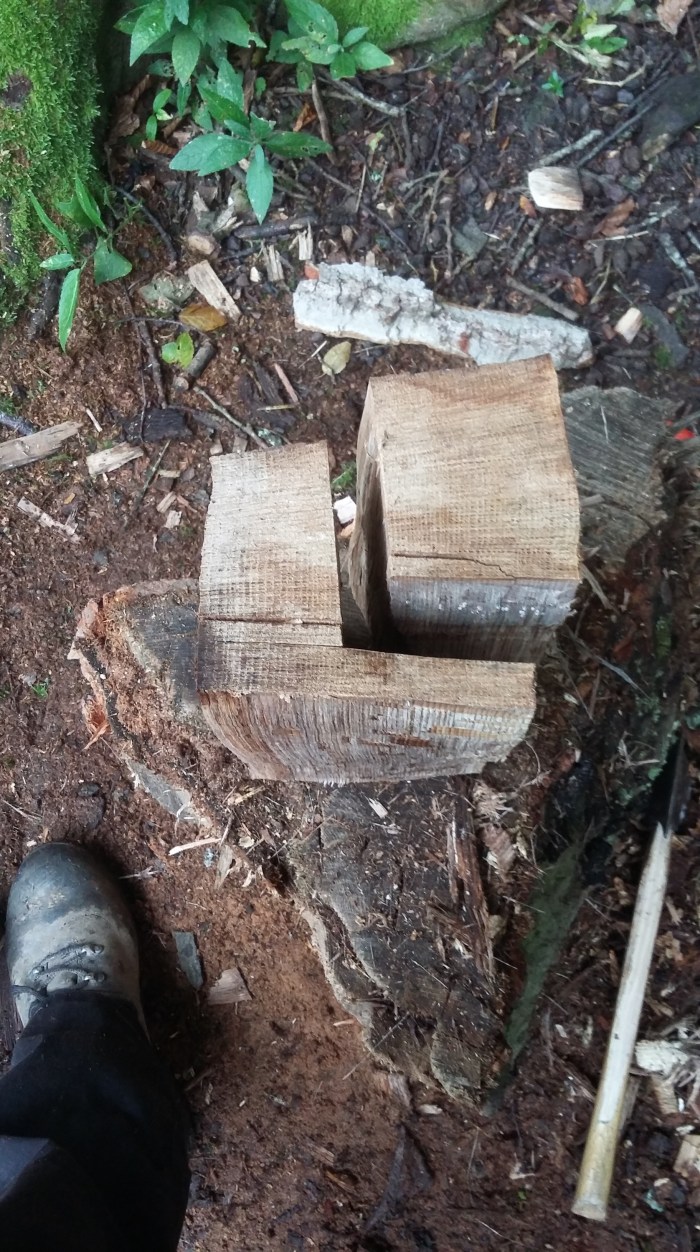
Just when you thought you understood the mechanism for wood splitting along the grain and in straight lines an odd thing happens.

20170920_093111

Very odd. More next time.